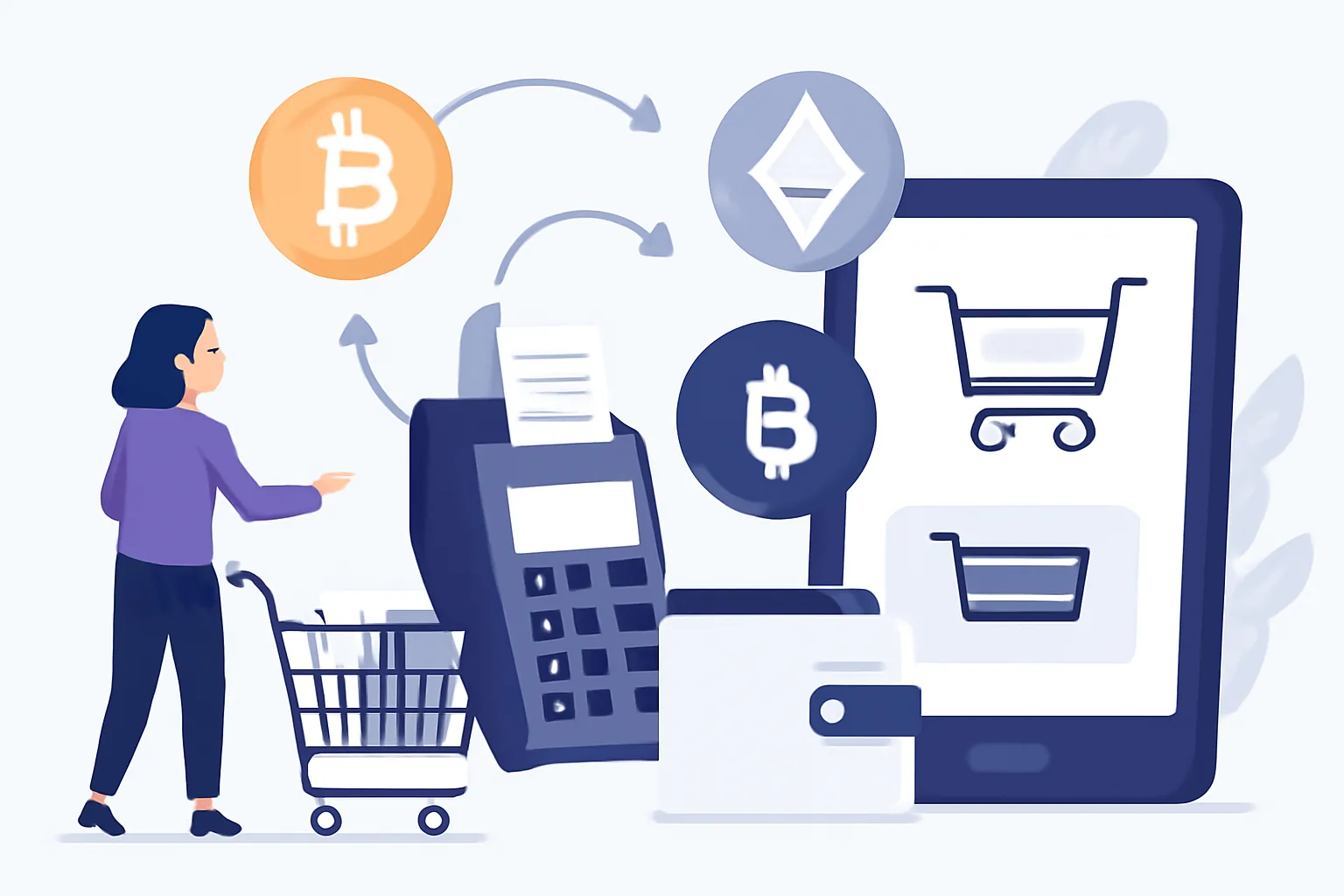
What a crypto payment gateway is and how it works
A crypto payment gateway for ecommerce is the checkout layer that lets a store accept crypto payments on website without handling the blockchain steps by hand. A customer picks a product, reaches checkout, and chooses a crypto payment option. The gateway then creates a payment request, shows an address or QR code, and waits for the transaction to arrive.
The basic flow is simple, but the details matter. The gateway may generate a fresh address for each order, calculate the amount in the selected coin, and track the payment until the network confirms it. Confirmation rules vary by provider and chain; some networks confirm in minutes, while others need more blocks before the order is marked paid.
Here is the part many store owners miss: the gateway is not the blockchain itself. It is the checkout tool between your cart and the chain. If you want a deeper technical overview before choosing a provider, the Crypto Payment Gateway for Ecommerce Guide is a useful companion read.
One practical example helps. A customer in Spain buys a digital download at 19:40, pays with crypto, and the gateway watches the transaction until the required confirmation count is reached. The store’s order status then changes from unpaid to paid, and the fulfillment step can begin. No manual wallet checking at midnight. Good for sleep.
Why ecommerce merchants accept crypto payments on website
Merchants accept crypto payments on website for a few direct reasons, and none of them need hype. First, crypto can open an additional payment path for customers who do not want cards or bank transfers. Second, it can help stores sell to buyers in countries where card approval rates are uneven or where local payment methods are limited.
Third, some customers simply prefer crypto. They already hold it, they already use it, and they want to pay without entering card details. That preference is especially visible in digital goods, subscriptions, services, and cross-border commerce. A store does not need every customer to use crypto; it only needs enough customers to make the option worth the setup.
There is also a customer experience angle. Some shoppers abandon checkout when a card is declined or when their bank adds friction. A crypto payment gateway gives them another path at the exact moment they might otherwise leave. That does not mean crypto replaces cards. It means the store has one more door open.
For ecommerce teams planning a broader rollout, it helps to compare the store model against platform-specific needs. The article on crypto payment gateway for WooCommerce is useful if your shop runs on WooCommerce and you want the practical side, not the sales pitch.
Non-custodial crypto checkout explained
Non-custodial crypto checkout means the merchant controls the wallet that receives the funds. The gateway helps create the payment request, but it does not hold the money on the merchant’s behalf. Funds move directly to the merchant wallet, which is the main difference from a custodial model where a third party receives and stores the balance first.
That difference sounds small. It is not. In a non-custodial setup, the merchant has more control over funds, more responsibility for wallet security, and less dependence on a payment intermediary for storage. The merchant must manage wallet access carefully, since loss of keys can mean loss of funds. There is no customer support desk that can “reset” a blockchain wallet.
Operationally, non-custodial crypto checkout can also change how accounting works. If the store wants automatic conversion to fiat, that usually requires a separate service or a gateway setting that supports it. If the store wants to keep crypto, the merchant can receive it directly and decide when, how, and whether to convert. That flexibility can be useful, and it also adds treasury decisions that card payments do not create.
Some providers offer hybrid models, where the merchant can receive funds directly or pass through a settlement layer. The exact setup depends on the provider, the wallet type, and the network supported. Before launch, test the payment path from checkout to wallet. One failed address format is enough to cause a bad afternoon.
Key features to look for in a crypto payment gateway for ecommerce
Start with coin and network support. A crypto payment gateway for ecommerce should support the coins your customers actually use, not just the ones that look good on a feature page. If your store serves global buyers, network support matters even more, because some customers care about fees and chain choice. A gateway that supports only one coin may be fine for a niche shop, but not for a store with broad international traffic.
Wallet control comes next. Decide whether you want non-custodial receipt, custodial storage, or both. Then check how the gateway handles settlement options, payout timing, and currency conversion. A merchant selling 200 orders a week may want faster fiat settlement for cash flow. Another merchant may prefer to hold crypto. The gateway should match the store’s actual workflow.
Checkout UX matters because the customer is still at the edge of purchase. The best crypto payment gateway for ecommerce makes the payment instructions plain: amount, coin, network, address, QR code, and time limit. If the customer has to guess which chain to use, conversion suffers. Nobody enjoys sending the right coin to the wrong network.
Plugin support is another practical filter. If the store runs on WooCommerce, WordPress, WHMCS, or a custom stack, the gateway should fit that stack with minimal friction. For merchants who want platform-specific setup guidance, the crypto payment gateway for WordPress article shows how a WordPress store typically handles this kind of integration.
Look for invoice tools, refund handling, webhook support, and order status updates. Refunds in crypto are not the same as card refunds, so the gateway should make the process clear. Webhooks matter because ecommerce systems need a reliable way to hear that payment has cleared. If the system cannot tell your cart that the order is paid, the rest of the flow stalls.
| Feature | Why it matters | What to check |
|---|---|---|
| Supported coins and networks | Matches customer preference | Coins, chains, fee levels |
| Wallet control | Defines who holds funds | Non-custodial or custodial model |
| Settlement options | Shapes cash flow | Crypto settlement, fiat conversion |
| Checkout UX | Helps customers finish payment | QR code, address, timer, clear network |
| Plugins and APIs | Affects implementation speed | WooCommerce, WordPress, custom API |
How to integrate crypto payments into an ecommerce website
The typical integration process starts with choosing a gateway that fits the store’s platform and payment model. Then the merchant creates a gateway account, connects a wallet, and decides which coins or networks to enable. After that, the store installs a plugin or adds API endpoints, depending on the ecommerce stack.
The next step is configuration. Set the payment currency, address format, confirmation count, order status rules, and notification settings. If the gateway supports invoices, test the invoice flow too. A good setup should make the order path obvious for both the customer and the store team.
Testing is the step that saves trouble later. Run a small test order, verify the amount, confirm that the payment lands in the right wallet, and make sure the cart updates after confirmation. For a practical pre-launch checklist, how to test a crypto payment covers the kind of checks that catch mistakes before customers see them.
Going live should be a deliberate switch, not a guess. Many stores launch with crypto enabled on a small set of products first, then expand once the team understands the workflow. That approach reduces support confusion. It also gives you time to train staff on payment confirmation, refund requests, and wallet handling.
Platform-specific setup can vary a lot. A hosted cart, a WordPress store, and a subscription billing system do not all need the same steps. If your business runs on hosting or recurring billing, the article about how to accept crypto payments is relevant because WHMCS adds its own invoice and renewal logic.
Security, compliance, and risk management
Security starts with wallet access. Store the keys in a controlled way, limit who can approve transfers, and separate operational access from admin access. A merchant should also verify deposit addresses carefully, especially if the gateway or wallet workflow includes copy-paste steps. One wrong character can send funds to the wrong destination permanently.
Price volatility is another risk. A customer may pay the correct amount in crypto, but the fiat value can move between checkout and settlement. Some merchants handle this by converting quickly, while others hold crypto and accept the movement as part of the model. The right choice depends on margin, treasury policy, and how much price change the store can tolerate.
Chargebacks are different too. Card payments can be reversed through issuer processes; crypto payments generally do not work that way. That lowers one type of dispute risk and raises another: if a customer sends to the wrong address, the recovery path can be limited or nonexistent. Customer support has to say that clearly before checkout, not after.
Compliance depends on jurisdiction, product type, and business model. KYC and AML requirements may apply to some providers or merchants, and tax treatment can vary by country. A store selling digital subscriptions to EU customers may face different rules than a store selling physical goods in one domestic market. If legal review is needed, get it before launch. The cost of checking is lower than the cost of reworking payment flow later.
Best practices to improve conversion at crypto checkout
Clear instructions help more than fancy design. Show the amount, the exact coin, the network name, the address, and the time window in plain language. If the customer must scan a QR code, place the text address nearby as a backup. Some people pay from a mobile wallet. Some use desktop. The checkout has to serve both.
Network messaging matters because many customers now hold the same asset on more than one chain. If your gateway expects a specific network, say so. A customer who sends USDT on the wrong chain may create a support case that takes longer than the original order. One small label can prevent that.
Fallback options help when crypto is not the best fit for a given customer. If your store also accepts cards or bank transfer, keep those paths visible. Crypto should be an additional option, not a hidden detour. A customer who cannot complete a crypto checkout should still be able to buy the product.
Support copy should be written like a checkout helper, not like a whitepaper. Use short lines, simple prompts, and a visible contact path. If the gateway includes an expiration timer, explain what happens when the timer runs out and whether the order can be recreated. That avoids confusion when a payment arrives late by a few minutes.
When a crypto payment gateway is a good fit for your store
A crypto payment gateway is a strong fit for stores that sell digital products, cross-border services, hosting, subscriptions, or other goods where buyers already know crypto. It can also suit merchants who want a non-custodial crypto checkout and direct wallet control. If your audience is international and already asks for crypto, the business case is usually easy to explain.
Stores with low margins on manual support may also benefit, as long as the payment flow is tested well. A gateway that updates orders automatically can reduce manual confirmation work. Still, the merchant needs a process for failed payments, partial payments, and expired invoices. Those cases happen, and they need a documented response.
Crypto is not the best fit for every ecommerce business. If your buyers need instant reversals, if your compliance rules are strict, or if your audience mainly prefers local card and bank methods, traditional payment methods may remain the main path. That is normal. A crypto payment gateway works best as part of a payment mix, not as dogma.
For stores that want to compare models before deciding, the practical question is simple: do your customers ask for crypto, and can your team support the workflow every day? If the answer is yes, the next step is a controlled test on one product, one wallet, and one checkout path.



Comments