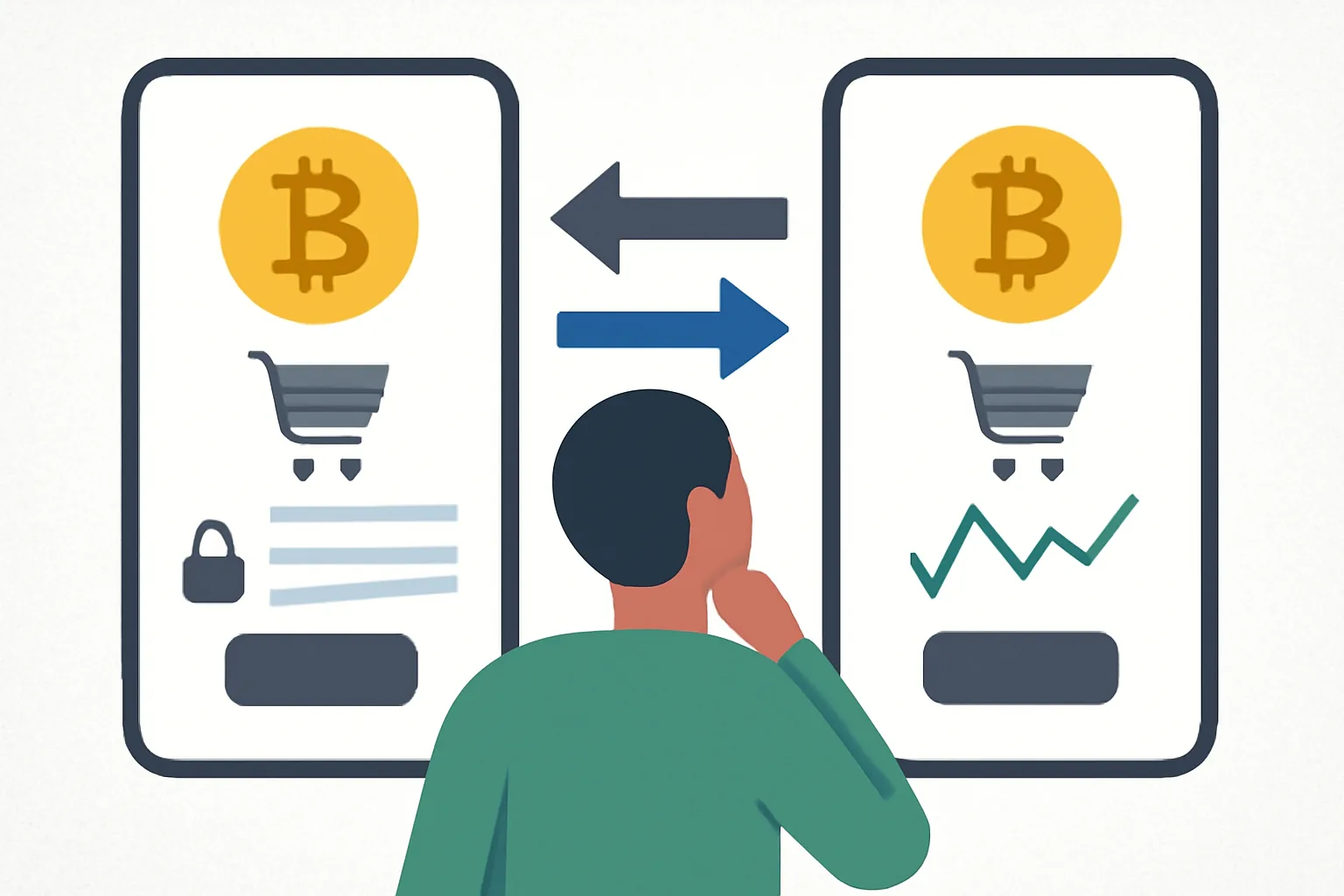
What “fixed price” and “live exchange rate” mean
At checkout, you usually choose between two pricing modes: fixed price and live exchange rate. Fixed price means the customer sees one crypto amount for a short window, and that amount does not change while the quote is valid. Live exchange rate means the crypto amount updates from market prices, often right up to payment time.
Here is the practical difference. If a shirt costs 50 USD, a fixed price checkout might lock that at 0.00125 BTC for 10 minutes, while a live exchange rate checkout might show a fresh BTC amount every few seconds. One feels like a quoted bill. The other feels like a moving market ticket.
The question, should I use fixed price or live exchange rate for crypto checkout, is really about which risk you want to hold. Price risk, customer confusion, accounting noise, and refund complexity all sit differently under each mode. There is no universal winner.
Comparison criteria that matter for crypto checkout
Start with volatility risk. Crypto prices can move while a customer is still copying an address or switching wallets, and that movement can hit a merchant’s margin or a shopper’s trust. A 2% swing is small on paper and annoying in practice.
Customer experience comes next. A shopper who sees one amount, waits 6 minutes, then gets a “payment not received” message because the quote expired is not having a good day. That person may not care about your treasury policy.
Payment completion matters too. Fixed price can raise completion rates when the customer needs a simple, frozen number. Live exchange rate can help if the customer wants the most current value and is ready to pay fast.
Accounting clarity is another filter. Fixed price makes it easier to reconcile 1 order with 1 expected crypto amount, especially for teams that still export invoices to spreadsheets. If you already run crypto payment gateway for ecommerce guide workflows, you know how much time gets lost when order totals and received amounts drift apart by tiny fractions.
Margin control is direct. A fixed price gives the merchant a buffer or a burden, depending on how the quote is set. Live exchange rate passes more of the market movement to the customer, which can protect the merchant from selling at yesterday’s price.
Refund handling also differs. If you refund in crypto, a fixed price can make the original payment easy to identify, but the fiat value may have shifted by the time the refund is processed. Live exchange rate can match the market more closely at purchase time, yet the refund still lives in a market that may have moved since then.
Fixed price vs live exchange rate: side-by-side comparison
| Criterion | Fixed price | Live exchange rate |
|---|---|---|
| Volatility risk | Merchant absorbs or buffers short-term price moves | Customer sees current market movement more directly |
| Customer experience | Clear and simple; one amount, one timer | Can feel fairer, but may change while the customer is paying |
| Payment completion | Often stronger for slower checkouts and first-time buyers | Often stronger for fast buyers who pay immediately |
| Accounting clarity | Easier to reconcile order totals and expected receipts | More exact market matching, but more variation in received amounts |
| Margin control | Stronger if you set a buffer and quote expiry carefully | Stronger if you want the market to set the price in real time |
| Refund handling | Straightforward on the order side, trickier on value over time | Cleaner on value at purchase, still exposed to later price shifts |
The table is the short version. Fixed price usually favors clarity and control. Live exchange rate usually favors market accuracy and fairness at the moment of sale.
Neither mode fixes bad checkout design. If the amount is hidden until the last step, or the wallet instructions are hard to copy, both options fail. That part is just craft.
When fixed price is the better choice
Fixed price is often the better choice for merchants who need price certainty. If your margin is thin, a 1% move can matter on a single order, and a 5% move can matter across a week of sales. A fixed price lets you decide in advance how much risk you will carry.
Fixed price is also easier when your checkout audience is new to crypto. A customer who only wants to buy one digital product should not have to watch a live chart while paying. Give that customer one amount and a timer, and they can finish in under 2 minutes.
Some teams need fixed price because the internal workflow is slow. If an order has to pass through support, fraud review, or manual approval, a live exchange rate can move away before payment arrives. For those cases, a fixed price is cleaner than chasing a floating amount after the customer has already left the page.
Fixed price helps with messaging too. Short copy works better: “Pay 0.0041 ETH within 10 minutes.” That is easier than explaining rate sources, spreads, and live re-pricing on every click. Plain words win. A checkout page should not read like a trading terminal.
There is also a practical reason for fixed price in businesses with high refund sensitivity. If you sell tickets, subscriptions, or preorders, you may need to explain value in one clean number to support staff, finance, and customers. A fixed quote keeps that explanation short. For teams building recurring sales, a crypto payment invoice limits policy can help define how long those quotes stay valid.
If you want a more conservative launch, fixed price is often the first step. Many merchants test the checkout flow with a narrow quote window, then widen it once payment completion looks stable. That approach is safer than guessing. For a practical pre-launch checklist, see how to test a crypto payment.
When live exchange rate is the better choice
Live exchange rate is better when you want the checkout to track the market closely. This matters most for larger baskets, fast-moving tokens, or shops that price inventory in fiat and settle in crypto without wanting to carry the spread themselves. One minute matters here.
It can also feel fairer to the customer. A shopper paying at 14:03 should pay the market rate at 14:03, not the rate from 14:00 if the page sat open while they searched for a wallet. That is a small difference on a stable day and a big one during a sharp move.
Live exchange rate suits merchants with tight operational discipline. If your checkout updates quote amounts reliably and your customer base is comfortable paying quickly, the live number can reduce friction around “why did my amount change?” complaints. The customer sees the market, and the merchant avoids being stuck with yesterday’s price.
This mode is often sensible for crypto-native products and services. If your buyers already hold crypto and expect current pricing, a live rate feels normal rather than strange. A freelance invoice sent in crypto is a good example; a dedicated flow like crypto payment gateway for freelancers often benefits from market-linked pricing because clients compare invoices against current value.
Live exchange rate also works better when your support team can explain timing clearly. “The rate updates every few seconds, so please pay within the window shown” is an easy rule if the checkout makes the timer visible. If the customer knows the rule, the rule is respected.
For merchants who care most about direct market tracking, live exchange rate can be the cleanest match. It shifts the pricing burden away from the merchant and toward the market, which is exactly what some teams want. Not every shop wants that. Some do.
Common trade-offs and edge cases
Quote expiry is the first edge case to watch. A 5-minute window feels generous until the customer opens a wallet app, gets distracted, and comes back at minute 6. Then the payment may arrive under the wrong amount, or the quote may need a refresh. That is one of the fastest ways to create support tickets.
Network delays are the second problem. On-chain confirmation can lag because of congestion, fee settings, or wallet behavior, and that lag can turn a valid payment into a borderline case if your rules are too strict. The checkout may say one thing, while the blockchain says another 12 minutes later.
Underpayment and overpayment handling deserve a written policy. If a customer sends 99.6% of the required amount, do you accept it, hold the order, or ask for the missing fraction? If they overpay by 1.2%, do you refund the excess or apply it as store credit? A policy beats improvisation.
Volatility can also affect completed orders after the payment is received. Suppose a customer pays at a live rate and then the coin drops sharply before you convert it. Your accounting may still be correct, but the fiat value is lower than it was 20 minutes earlier. That loss belongs to someone, and your pricing mode decides who.
There is a smaller edge case that still causes pain: quote drift during wallet switching. A customer may start in one browser tab, move to mobile, then return to the first tab and expect the same number. Fixed price makes that expectation easier to meet. Live exchange rate makes it harder, unless your UX keeps the timer visible and resets the rate clearly.
If you accept tokens with fast changes, test the payment rules before launch. One hour of bad testing can become 100 support messages later. That math is ugly. Use a checklist and write down the exact behavior for expired quotes, partial payments, and delayed confirmations.
Honest verdict: which one should you use?
If your team is small, fixed price is usually the safer first pick. It reduces moving parts, shortens explanations, and gives finance one expected amount to compare against the received amount. For merchants still learning crypto checkout, that matters more than perfect market timing.
If your team already has payment operations under control, live exchange rate can be the better fit. It is stronger for merchants who want current pricing, can answer customer questions quickly, and are comfortable letting the market move the number on the screen. That is a very specific setup.
Risk tolerance should decide the final choice. If a 3% change in 10 minutes would hurt you, fixed price is the safer structure. If you would rather not absorb that swing and your buyers can pay fast, live exchange rate is the cleaner option. One is not morally better.
There are also mixed setups. Some merchants lock a quote for 10 minutes, then refresh it if payment does not arrive. Others use a live exchange rate but show a small buffer so the received amount still clears after network fees. Those are valid choices, but they need testing, not optimism.
Before launch, check the legal and operational side if you are using non-custodial flows or cross-border settlement. The payment mode does not remove the need for policy. If your team wants a jurisdiction-specific read, is non-custodial crypto payment processing legal is worth a look.
So, should I use fixed price or live exchange rate for crypto checkout? For most new merchants, fixed price is the calmer starting point. For merchants with strong systems, frequent price changes, or buyers who expect market-linked pricing, live exchange rate can be the better fit.
Final takeaway for Payora readers
Use fixed price if you want one amount, one timer, and fewer surprises. Use live exchange rate if you want the checkout to follow the market and you can handle timing, support, and refund rules without guesswork. That is the simplest rule, and it holds up in real checkout teams with real orders.
Pick the mode that matches your weakest day, not your best one. If your team can still miss a quote expiry at 4 p.m. on a Friday, start with fixed price. If your checkout already handles fast market updates without drama, live exchange rate may be the right next step.


Comments