
Accepting crypto payments on a website sounds technical at first, but the idea is straightforward: a customer chooses to pay with cryptocurrency, the website shows the amount due, and the payment is confirmed on the blockchain or through a payment provider that handles the heavy lifting. For a merchant, the goal is to make that process feel as ordinary as card checkout, even if the rails behind it are very different.
In practice, this can mean accepting Bitcoin, Ethereum, stablecoins, or other supported assets through a crypto payment gateway, then receiving settlement in crypto or, in some cases, in fiat. Some businesses use crypto because their customers already prefer it. Others use it because they sell internationally and want an additional payment option that does not depend on card networks alone, and if you are planning the rollout carefully, it helps to understand the mechanics first. A broader overview of the ecommerce side of this topic is covered in Crypto Payment Gateway for Ecommerce Guide.
What “accept crypto payments on a website” means
At the simplest level, accepting crypto payments means your website can present a price in a supported cryptocurrency, receive the payment, and mark the order as paid once the transaction is confirmed. That confirmation may happen directly on-chain or through a provider that monitors the blockchain and notifies your store through a callback or webhook.
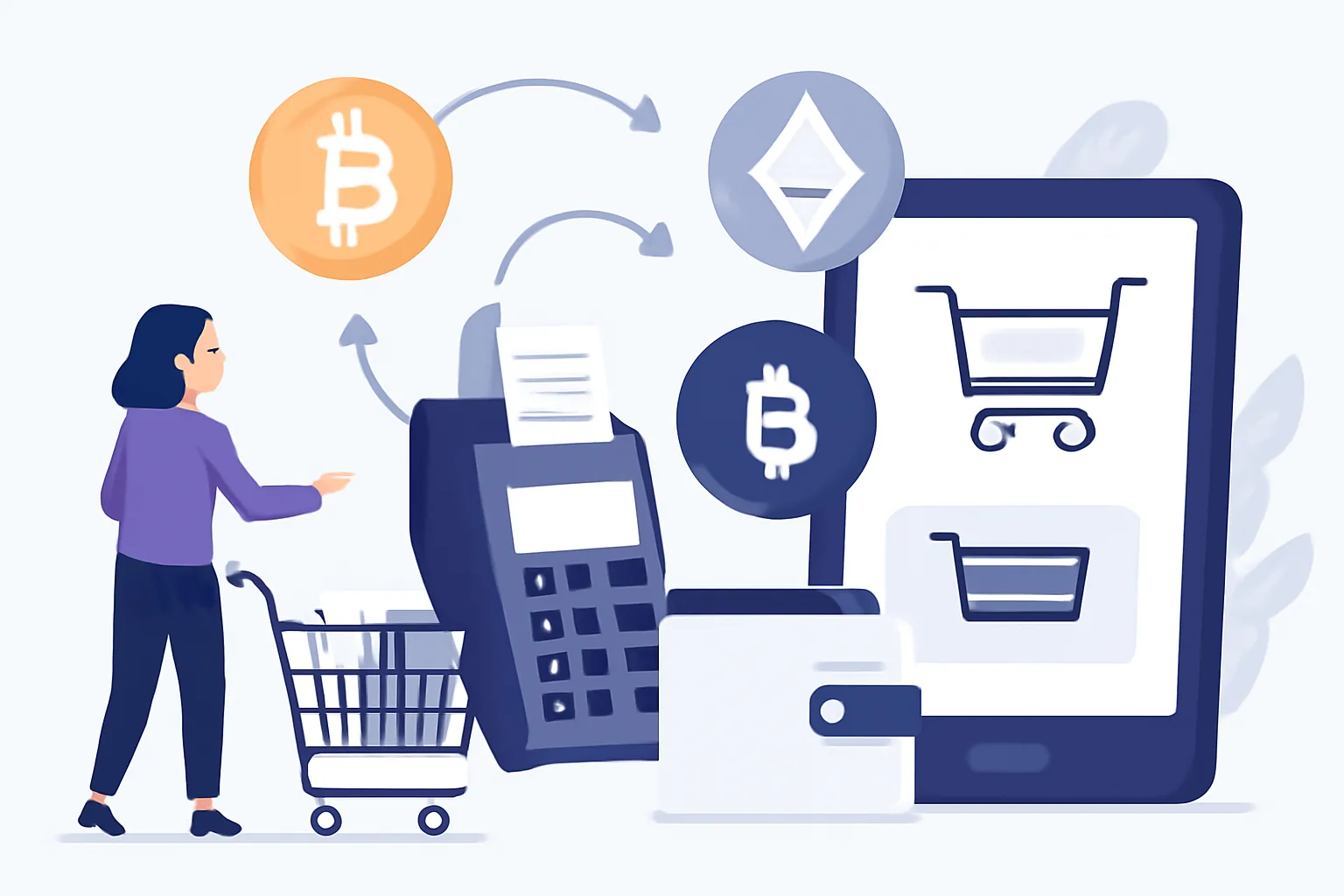
The basic flow usually looks like this:
- The customer adds products or services to the cart.
- At checkout, they choose crypto as the payment method.
- The website or payment gateway generates a payment request.
- The customer sends the required amount from their wallet.
- The gateway confirms receipt and informs the website.
- The order is released for fulfillment.
For the merchant, the important part is not simply “taking crypto.” It is taking crypto in a way that fits the existing website workflow: order status, inventory, delivery, invoicing, and support all need to work as expected. A good implementation should not force your team to manually cross-check addresses and transactions all day long. That is where payment infrastructure matters.
Why businesses consider crypto payments
Businesses usually explore crypto payments for a mix of practical and strategic reasons. One of the most common is payment choice. Some customers already hold digital assets and prefer to spend them directly rather than convert to fiat first, and for those users, crypto can reduce friction at checkout.
Cross-border business is another reason. Crypto is often attractive to merchants selling internationally because it can reduce dependence on local card acceptance and bank availability. In some markets, customers may find it easier to pay with a wallet than with a card issued abroad. That does not make crypto a universal solution, but it can be a useful additional lane.
Settlement speed is another factor. Compared with some traditional methods, crypto can feel faster because the payment event itself is visible quickly and can be handled automatically by the gateway, and for digital goods, software access, or certain service workflows, that can be a real operational advantage.
Chargebacks are often mentioned in this conversation, but this is where nuance matters. Crypto payments do not work like card payments, and the dispute mechanics are different. That may reduce some types of payment reversal risk, but it also means merchants need their own refund and support processes. If you sell high-ticket items or custom services, you cannot rely on card-network dispute rules to solve sloppy checkout copy or unclear delivery terms.
There are tradeoffs, too. Volatility can matter if you hold crypto directly. Accounting may be more complex. Some customers will be comfortable with wallet addresses and network fees; others will not. If your store is introducing crypto for the first time, treat it like any other payment method launch: test the user experience, train support, and make sure the accounting side is not an afterthought.
How a crypto payment gateway works
A crypto payment gateway sits between your website and the blockchain layer, and it creates a clean payment experience for the customer while handling many of the technical details for the merchant. Instead of exposing raw wallet operations directly, the gateway can generate an invoice, calculate the equivalent amount in the selected currency, watch the network for payment, and notify your store when the transaction is complete.
In many setups, the merchant receives a dashboard where orders, payments, and settlement settings can be monitored. Some gateways provide hosted checkout pages. Others provide APIs or plugins that integrate with ecommerce platforms, billing systems, or custom sites.
Useful comparison points include:
- Supported cryptocurrencies and networks
- Whether the provider supports fiat pricing with crypto settlement
- Wallet or custodial account options
- Webhook reliability and API documentation quality
- Plugin support for your ecommerce platform
- Manual approval tools for edge cases
- Customer support responsiveness
For businesses evaluating fees and cost structure, it is worth reading the fine print carefully. Payment processing in crypto can involve network costs, gateway fees, conversion charges, or settlement spreads. A useful companion article on that topic is Comisiones de pasarela de pago cripto.
Hosted checkout vs. embedded payment flows
One of the first design choices is whether to send customers to a hosted checkout page or embed the payment flow directly on your site, and both approaches can work well, but they serve different priorities.
Hosted checkout means the customer is redirected to a secure payment page managed by the provider. The page typically displays the invoice, payment instructions, timer, QR code, and confirmation status. The merchant’s website creates the payment request, but the actual payment interface is hosted elsewhere.
This approach is popular for several reasons. It is usually faster to deploy, especially for teams without dedicated developers, and it can reduce the amount of sensitive payment logic on your own site. And it often gives the customer a very focused payment experience, with fewer chances for the checkout to break because of a custom theme or plugin conflict.
Embedded payment flows, by contrast, keep the customer on your website. That may mean a payment widget, an inline form, or an API-driven checkout experience that looks and feels like a native part of the store. For some merchants, that is worth the additional complexity because it keeps branding consistent and avoids redirection during checkout.
The tradeoff is clear: hosted checkout tends to be simpler and safer to launch quickly, while embedded flows offer tighter UX control but usually require more development and more attention to security. If your team is short on engineering resources, hosted checkout is often the better first step. If you have a custom storefront and want full control over the payment journey, an embedded flow may be the better long-term fit.
There is no single right answer. A B2C store selling gift cards may want a frictionless hosted page. A software company billing enterprise clients might prefer a more integrated flow that feels native inside an account portal. The right choice depends on how much control you want over the checkout experience and how much responsibility you are ready to assume for maintenance.
Steps to add crypto payments to a website
The setup process is usually manageable if you approach it in order, and start by choosing a provider that fits your business model. A store with recurring invoices has different needs from a marketplace or a one-time ecommerce checkout. Before you integrate anything, map out the real workflow: where payment begins, how the order is marked as paid, who gets notified, and how exceptions are handled.
A practical rollout usually follows these steps:
- Create an account with the crypto payment provider.
- Complete any required business verification or setup steps.
- Choose your supported currencies and payment networks.
- Decide whether you want settlement in crypto, fiat, or both.
- Install a plugin, connect via API, or configure hosted checkout links.
- Set pricing rules and invoice expiration settings.
- Run test transactions before going live.
- Confirm webhooks, email notifications, and order status updates.
- Launch with a small customer-facing announcement and monitor closely.
Testing deserves special attention. You want to confirm that the amount displayed matches the amount requested, that the payment status changes correctly, and that underpayments or expired invoices are handled cleanly. If you want a more detailed pre-launch checklist, this guide on how to test a crypto payment is a useful reference.
For some merchants, plugin-based integration is the fastest route. For others, an API is worth the effort because it allows tighter control over checkout, order management, and post-payment automation. Either way, do not skip internal testing. A live customer is not the place to discover a webhook misfire.
Security, compliance, and risk controls
Security is not a box to tick at the end. It should shape the implementation from the start. The first decision is how you handle funds. Some merchants prefer non-custodial control over their wallets, while others use provider-managed accounts. If you control the wallet, key management matters. If the provider controls part of the flow, then account security, access controls, and provider due diligence matter even more.
Fraud prevention also looks a little different in crypto, and transaction irreversibility means you need strong checks before you ship goods or release digital access. That includes verifying invoices, preventing order manipulation, and making sure customers cannot reuse old payment references. For high-risk products, manual review may still be necessary.
Compliance requirements depend on jurisdiction, business type, and transaction model, and in some cases, KYC/AML obligations may apply to the merchant, the payment provider, or both. This is one reason businesses should read provider documentation carefully and, when needed, seek legal or compliance advice rather than guessing.
Refund policy deserves equal attention. With crypto, a refund may involve sending funds back to a wallet address, potentially in the original currency or in another asset depending on your policy and the provider’s capabilities. Spell out how refunds work, how long they take, and whether network fees are deducted. Customers appreciate clarity, even when the answer is not the one they hoped for.
Finally, publish clear payment terms. Tell customers which cryptocurrencies you accept, whether prices are locked for a limited time, what happens if they send the wrong amount, and where to contact support. Hidden rules create confusion. Clear rules reduce tickets.
Best practices for pricing, refunds, and customer support
Pricing crypto payments well is part finance, part communication. Your product page may show prices in fiat, but the checkout step converts the amount into crypto using a live rate or a provider-defined rate, and make sure the customer understands what is happening. If the invoice expires after a short window, say so plainly. If the rate is locked for a limited time, say that too.
Volatility is the obvious challenge. Merchants have a few common ways to manage it: convert immediately to fiat, keep only a portion in crypto, or settle in crypto and convert later. Each approach has its own risk profile. The right choice depends on treasury policy, not just payment convenience.
Failed or underpaid transactions deserve a defined process. If a customer sends too little, do you request a top-up, issue a partial refund, or cancel the order? If the payment arrives after the invoice expires, how do you handle it? These are not edge cases in practice; they are routine support questions once you start accepting crypto.
Customer support should assume that many buyers are new to crypto payments. That means your team may need to explain things like wallet confirmations, network selection, QR codes, and the difference between sending to the right address on the wrong chain. A calm, precise answer can save a sale. A vague answer tends to create one more ticket and one less repeat customer.
It also helps to use plain language in the checkout itself. Avoid technical jargon unless it is necessary. “Pay with crypto” is better than a page full of network terminology no one asked for, and if your audience is more technical, you can always add a help link or a support note nearby.
How to choose the right provider
Choosing a crypto payment gateway is less about finding the longest feature list and more about matching the tool to your actual business. A small shop with modest volume may value speed and simplicity. A larger merchant may need stronger API control, accounting workflows, and dedicated support, and the key is to compare providers on the details that affect revenue capture and day-to-day operations.
Start with currency coverage. Does the gateway support the assets your customers actually use? Are stablecoins available if you want less exposure to volatility? Next, look at integration options. A strong provider should fit your website without forcing a rebuild. Plugins, hosted checkout, API access, and documentation quality all matter.
Fees and settlement terms should be examined together. A low advertised fee is not automatically the best deal if conversion terms, withdrawal timing, or support limitations make the service harder to use. Settlement method matters too. Some businesses want direct wallet control. Others prefer a provider account with simpler reconciliation, and neither is universally better; what matters is operational fit.
Support quality is easy to ignore until you need it. Ask how the provider handles onboarding questions, failed webhook events, invoice disputes, and account issues. If you are launching crypto payments for the first time, responsive support is not a luxury. It is part of the rollout plan.
For merchants focused on ecommerce implementation details, the broader guide on Crypto Payment Gateway for Ecommerce Guide can help you compare setup patterns and choose a flow that matches your store. If you are still deciding between hosted and embedded checkout, or wondering how payments should move through your site architecture, that is a good place to start.
Conclusion
Accepting crypto payments on a website is no longer an experimental idea reserved for niche communities. For many merchants, it is simply another way to reduce checkout friction, reach international buyers, and diversify payment options. The technology can be straightforward if the process is designed carefully: choose the right gateway, test the flow, define your refund rules, and make support easy to reach.
The real success factor is not whether you “support crypto” in a headline sense, and it is whether the payment experience works smoothly for the customer and cleanly for your team. If both sides can use it without confusion, then crypto becomes what it should be: just another working payment method.



Comments