What a crypto payment gateway for SaaS is
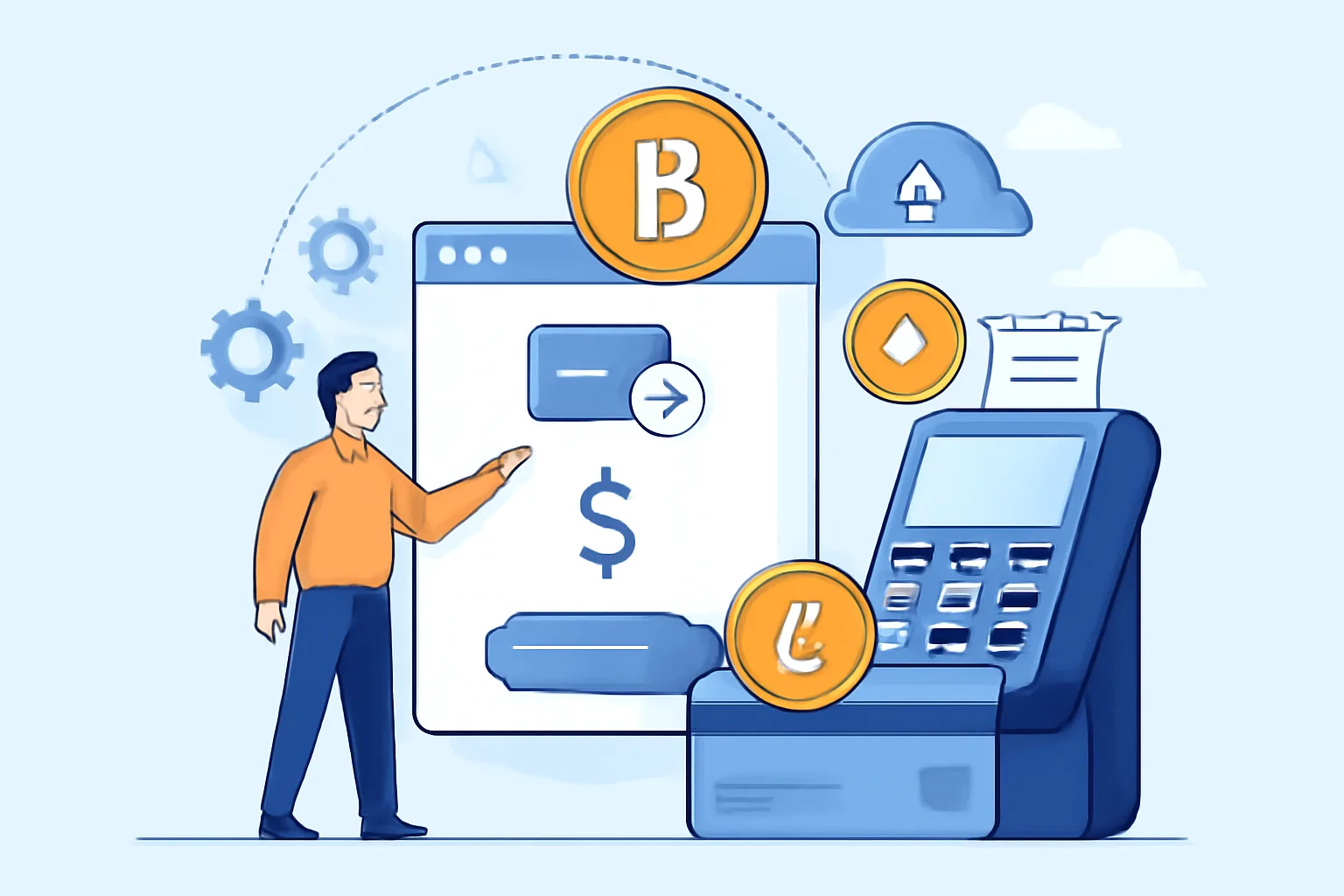
A crypto payment gateway for SaaS is the layer that lets a software business accept cryptocurrency payments for subscriptions, trials, upgrades, and one-time charges. In practice, it sits between your checkout page and the blockchain or payment infrastructure behind it. The goal is straightforward: make crypto payments feel like part of your normal billing flow, not a separate technical experiment.
For a SaaS company, that usually means the gateway creates a payment request, shows the customer what to pay, confirms when the transaction is received, and then signals your billing system so access can be activated or renewed. If you already use a conventional processor for cards or bank transfers, crypto becomes another payment rail rather than a replacement for everything else.
That distinction matters. SaaS billing depends on timing, status changes, and user entitlement. A gateway that works for simple e-commerce orders may not be enough on its own. Subscription logic is more demanding, which is why many teams study crypto payment gateway for subscription billing before wiring it into a recurring revenue stack.
Compared with traditional processors, the biggest difference is how payment confirmation happens. Card systems usually authorize first and capture later, with chargeback rules and card network intermediaries in the middle. Crypto transactions, by contrast, are typically pushed by the customer to a wallet address or through a connected wallet flow, and the gateway watches for network confirmation. There is no card number, no monthly card expiration update, and no stored card credential to maintain in the same way. There are also fewer familiar safety nets, which is why design and operations both matter.
Why SaaS companies consider crypto payments
Most SaaS teams do not add crypto because it is trendy. They do it because the business has a concrete problem to solve. Sometimes the issue is reach: a customer in one market may not have easy access to cards that work internationally. Sometimes it is preference: some buyers simply want to pay from a wallet they already use. And sometimes it is positioning: if your product serves developers, founders, or Web3 users, crypto can feel natural rather than novel.
Broader payment options are the obvious advantage, but there is more going on underneath. Crypto can reduce the friction of cross-border billing in cases where conventional payments are awkward. It can also help SaaS companies serve crypto-native customers who expect wallet-based checkout and prefer to hold or spend digital assets rather than convert into fiat first.
There is also the practical matter of audience fit. A SaaS tool for trading, analytics, hosting, gaming, or digital services may already attract users comfortable with crypto. In those cases, accepting crypto is not a gimmick; it is part of meeting the customer where they are.
Some teams also look at crypto as a backup payment method. If a customer cannot complete a card payment because of bank restrictions, fraud blocks, or regional limitations, a crypto option can rescue the sale. That is especially useful for higher-value B2B subscriptions where losing one account costs more than the friction of supporting an additional payment method.
Still, “more options” is not automatically “better.” If you add crypto, you need a clear reason, a clean customer flow, and a support team ready for the questions that follow. A wallet payment has its own learning curve, and poor implementation can create more tickets than revenue. That is why many companies start by mapping the customer journey first, then choosing the technology second. For teams comparing models across digital businesses, the broader crypto payment gateway for ecommerce guide can also be useful, even if your final use case is subscription-first.
How to accept crypto payments for software subscriptions
Accepting crypto payments for software subscriptions is less about “taking a payment” and more about managing a subscription state machine. A single order is easy. A recurring contract is not. You have to decide when the invoice is generated, how long it remains valid, what happens after partial payment or underpayment, how renewals are triggered, and when access changes in your app.
The first step is defining what “subscription” means in your crypto context. In card billing, the processor can often retry a failed payment on the same account. In crypto, renewal usually works differently. You may issue a new invoice for each billing cycle, ask the customer to pay from the same wallet or a different one, and then confirm settlement before extending service. That can be perfectly workable, but it changes the cadence of billing.
Recurring invoices are common. A gateway may generate a unique payment address or invoice reference for each renewal period. Once payment is detected on-chain, the gateway sends a callback to your billing system so the subscription can be marked active. If the payment arrives late, you can choose whether to honor it, apply it to the next cycle, or treat it as an exception. Those rules should be decided before launch, not in the middle of a support incident.
Invoice timing also deserves attention. Some SaaS businesses issue the renewal invoice several days before the due date so customers have time to pay without interruption. Others wait until the cycle date and suspend access only after a grace period. There is no universal rule, but there should be a predictable one. Customers dislike uncertainty more than they dislike paying in crypto.
Wallet support is another practical point. Some users will pay from a self-custody wallet, others from an exchange wallet, and others via a connected wallet flow. Your gateway should tell you what it supports and what your customers will actually experience. If the flow only works cleanly for one type of wallet, say so clearly in the checkout instructions.
Finally, subscription in crypto often means choosing between automatic and manual renewal behavior. True card-style auto-renewal is rarely identical in crypto because the user usually needs to approve each payment from a wallet. That does not make subscriptions impossible; it just means the system is closer to “renewal invoice plus payment confirmation” than to invisible monthly card charging.
What crypto checkout for SaaS websites should include
A strong crypto checkout for SaaS should feel deliberate and calm. The customer should not have to guess what is happening or hunt for the next step. The page should show the plan name, the billing period, the total amount due, the asset being requested, and a clear status indicator. If the price is locked for a limited window, say that plainly.
Pricing display matters more than many teams expect. A subscription checkout may show the plan in fiat terms while calculating the crypto equivalent at the moment of invoice creation. That conversion step should be visible enough to reduce confusion, especially when the asset price moves quickly. If you support stablecoins, that can simplify the experience, but the user still needs to know exactly what they owe and where to send it.
Wallet connection is another area where simplicity wins. If your flow supports a connected wallet, keep the prompt short and specific. If the user must copy an address, show it in a format that is easy to scan and verify. A QR code is useful, but it should not be the only path. People pay from desktops, phones, browser extensions, and mobile wallets; the checkout should respect that variety.
Payment confirmation should be visible on the page before the customer wonders whether anything worked. Many gateways show a “waiting for payment” state, then transition to “confirmed” once the network conditions are satisfied. That callback handling is critical because your application should not rely on the user refreshing the page at the right moment. The gateway needs to notify your backend directly.
Clear user instructions can prevent a surprising amount of support traffic. Good instructions explain which network to use, whether the exact amount must be sent, how long the invoice remains open, and what happens if the amount is short or arrives after expiry. You do not need a legal novella. You need a checkout that reads like a competent human wrote it.
If you are designing this from the ground up, it can help to look at patterns from other integration-heavy businesses. Even though the billing logic differs, the same principle applies: reduce guesswork. A practical reference point is how a crypto payment gateway fits into ecommerce, which shares several customer-experience lessons relevant to SaaS checkout design.
Key features to look for in a SaaS crypto gateway
Choosing a gateway for SaaS is mostly an exercise in operational fit. The product should match your billing model, your engineering capacity, and your customer base. Here are the features that usually matter most.
- Supported coins and networks, including the assets your customers actually want to use.
- Stablecoin support, which can reduce volatility friction in subscription billing.
- Checkout customization so the payment page matches your brand and product flow.
- API and webhook support for invoice creation, payment confirmation, and subscription status updates.
- Settlement options that fit your treasury policy, whether you want to hold crypto or convert quickly.
- Security controls such as address validation, payment verification, and access to audit logs.
- Support for partial payments, underpayments, and expired invoice handling.
- Documentation that your developers can actually work with without a week of guesswork.
Settlement choices deserve special attention. Some companies want to receive crypto directly and manage treasury exposure themselves. Others prefer automatic conversion to fiat or stablecoins to reduce volatility. There is no single right answer, but there is a right answer for your finance team, and it should be decided before the first customer pays.
Security also deserves more than a checkbox. A SaaS gateway should help you avoid misapplied payments, duplicated invoice states, and manual reconciliation mistakes. The best systems make it easy to trace a payment from invoice creation to final confirmation. That may sound boring. In billing, boring is good.
Integration options for SaaS platforms
SaaS platforms usually integrate crypto payments in one of four ways: hosted checkout, API-based flows, plugins, or custom billing stack integration. Each has trade-offs.
Hosted checkout is the fastest path. The gateway handles the payment page, address generation, and confirmation flow, while your application listens for a webhook or callback. This is ideal when you want to launch quickly or test demand before investing in deeper engineering work. The downside is less visual control.
API-based flows offer more flexibility. Your team creates invoices from your own backend, passes the payment details to the gateway, and updates subscription status when the webhook arrives. This is a stronger fit for SaaS products with custom pricing, usage-based billing, or multiple plan tiers. It does require careful implementation, because your app becomes responsible for more of the logic.
Plugins can be useful if your SaaS stack sits on a common platform with ready-made extensions. They can reduce development time, though the trade-off is less flexibility when your billing rules become more sophisticated. Custom integration is the most work, but also the most future-proof if your product has unusual renewal logic or enterprise account workflows.
Whichever path you choose, map the billing lifecycle before implementation. Decide how trials convert, how upgrades are handled, whether proration exists, and how a failed crypto renewal affects access. The gateway should fit into those decisions, not force you to redesign them later.
Risks, compliance, and operational considerations
Crypto payments introduce some familiar business concerns and some that are unique. Volatility is the first obvious one. If you accept a volatile asset and delay conversion, the value of the payment may change before settlement. That can be acceptable for some businesses and disastrous for others. Stablecoins reduce the issue, but do not eliminate operational complexity.
Refunds and chargebacks are another difference. Crypto payments do not behave like card payments, so there is no built-in chargeback process in the same sense. That reduces one kind of dispute but creates another: once a transfer is confirmed, reversing it may require manual action and mutual cooperation. Your refund policy should explain how that works in practice.
Accounting is not glamorous, but it matters. You need a way to record the invoice value, payment date, asset received, conversion rate if applicable, and any fees. Finance teams often want a clean reconciliation trail from invoice to ledger entry. If your gateway cannot support that, the hidden cost shows up later in bookkeeping time.
Tax treatment and reporting can also vary by jurisdiction. What counts as revenue, when it is recognized, and how digital assets are accounted for may differ depending on where the company operates. The same is true for KYC/AML requirements, which can depend on the service, the customer type, and the countries involved. It is worth getting advice from qualified professionals rather than treating crypto billing as a purely technical choice.
There is also the customer-support reality. Some issues are predictable: wrong network, expired invoice, underpayment, or payment sent from the wrong wallet. If your team knows how to resolve those cases quickly, the whole system feels much more mature. If not, the user experience can unravel fast.
Best practices for launching crypto payments on SaaS
The cleanest launches usually start small. Pick one plan, one asset family, and one billing path. Test the flow internally before exposing it to customers. If your team can complete a payment, trigger the webhook, and unlock access without manual intervention, you are in a much better place than if everything relies on hand-holding.
Testing should cover more than “did the payment go through?” Verify expired invoices, duplicate callbacks, delayed confirmations, wrong-amount payments, and the edge cases your support team is likely to see on day one. If you want a structured approach, it is worth reading how to test a crypto payment, because the same discipline applies whether your customers are shopping or subscribing.
Educate users before they reach the checkout. A short help note can explain which wallets are supported, whether they should use a specific network, and what to do if payment confirmation takes a while. The point is not to overexplain. It is to reduce preventable confusion.
Keep a fallback payment method available. Some customers will want crypto, others will prefer cards or bank transfers, and some will begin with one method and end with another. SaaS billing works best when the user can move forward without opening a support ticket just to finish paying.
Monitor the operational side closely after launch. Track conversion, failed payment rates, support questions, and renewal completion. You do not need to chase vanity metrics. You need to know whether the new payment method is helping actual customers finish subscriptions smoothly.
If you are building a broader payment strategy for a software business, it can also help to compare how crypto flows behave across different models. A subscription-centric reference like crypto payment gateway for subscription billing can be especially useful when you are refining recurring payment rules and customer messaging.
In the end, the best crypto payment setup for SaaS is the one customers barely notice. It should be clear, reliable, and just boring enough to trust. That is the real win: not merely accepting crypto, but making it part of a subscription experience that feels orderly from the first invoice to the next renewal.




Comments