
Short answer: GDPR compliance depends on your data role, not the custody model
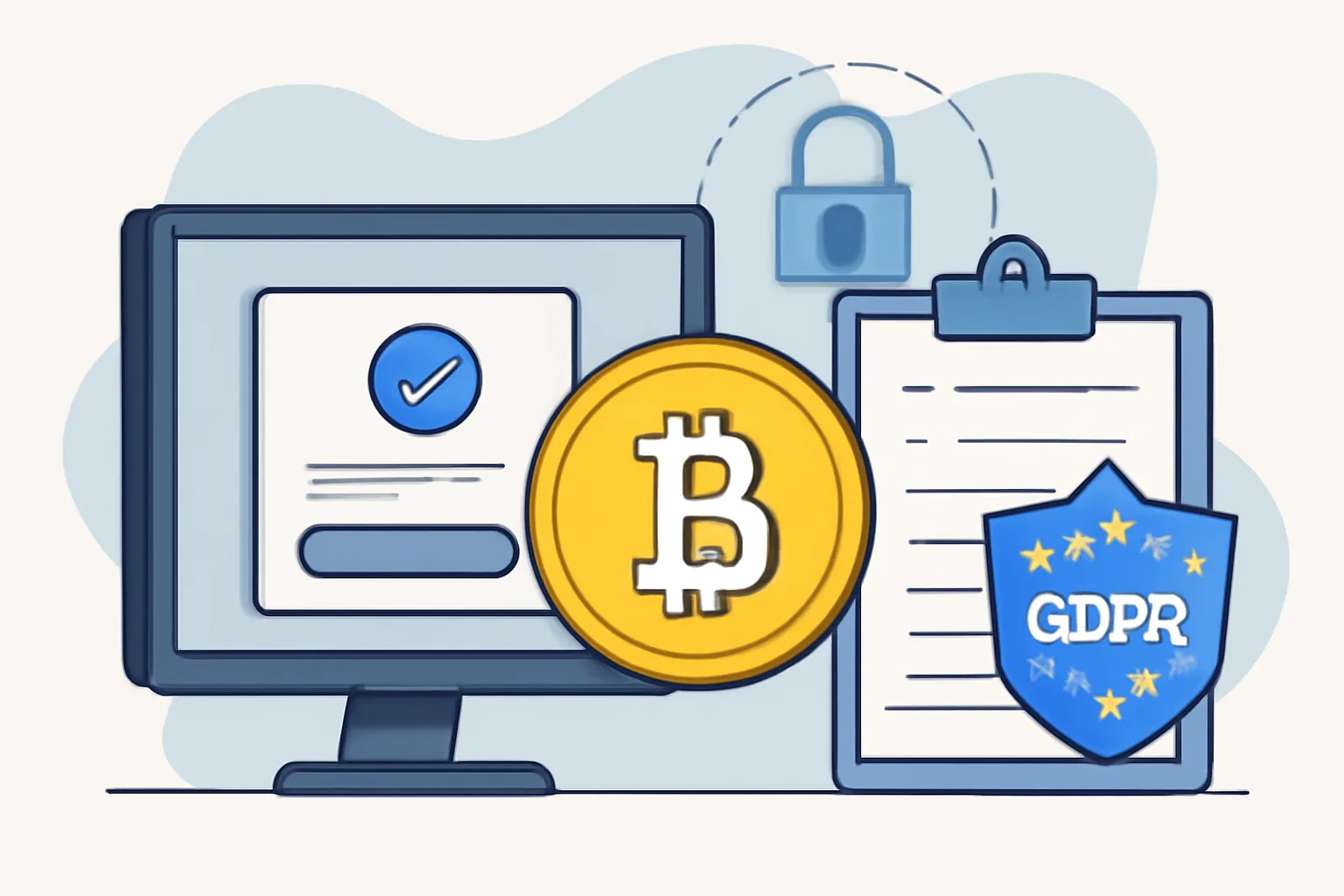
A non-custodial setup does not get a free pass. GDPR looks at personal data, the purpose of processing, and the role each party plays. If a gateway or merchant handles names, emails, wallet traces, support messages, or even a device fingerprint, GDPR can apply.
The phrase “is a non-custodial crypto payment gateway compliant with GDPR” sounds like a yes-or-no question, but the law is messier than that. A gateway can avoid holding customer funds and still process personal data every minute it is running checkout, logs, fraud checks, or customer support. The custody model matters for security design; it does not decide GDPR on its own.
Think of a simple checkout. A customer pays in USDC, the system records an order number, the wallet address, the timestamp, and an IP address. That is already enough to trigger a GDPR review if the payment can be tied to an identifiable person, which it often can through invoices, account data, or support records.
For merchants, the practical question is sharper: who decides why the data is collected, and who controls the means? That answer determines whether the merchant is a controller, the gateway is a processor, or both parties share responsibility. One label rarely fits every workflow.
Which parties are usually controllers, processors, or joint controllers
In a typical crypto checkout, the merchant is usually the controller for customer data tied to the sale. The merchant decides what is sold, what gets stored, and how long the purchase record stays in the order system. That alone creates a clear GDPR footprint.
A gateway provider may act as a processor if it processes data only on the merchant’s instructions. That is common when the gateway renders checkout, creates payment instructions, and sends payment status updates. If the provider also decides to reuse the data for product analytics, risk scoring, or its own customer database, the role can shift. Then the gateway may become a controller for those separate purposes.
Wallet infrastructure, blockchain indexing tools, analytics vendors, and hosting providers usually sit in the background as processors or sub-processors, but the facts matter. A node operator running only technical infrastructure may have limited exposure. A service that correlates transactions across merchants can move into controller or joint-controller territory.
Joint controllership is not rare. It appears when merchant and gateway both decide on parts of the same processing operation, such as shared fraud review rules or a jointly branded checkout flow. In that case, both parties need a written arrangement that explains who handles notices, access requests, and security incidents. Three words matter here: who does what.
Merchant teams often miss the role of support tools. A helpdesk that stores customer screenshots, refund emails, and wallet screenshots is not “just support.” It processes personal data, and its vendor contract should say so. The same is true for ticketing systems and CRM tools.
What personal data a non-custodial gateway may still process
Non-custodial does not mean data-free. A gateway may process IP addresses, email addresses, wallet addresses, device data, transaction IDs, browser language, invoice references, and refund notes. Each item can become personal data once it can be linked to a person directly or indirectly.
Wallet addresses deserve special care. On their own, they may look like random strings. In practice, the address can be tied to a customer through an account, an invoice, a support exchange, a shipping label, or a KYC file. One identifier can become many things.
Logs are another trap. A 90-day server log may include IP addresses, request headers, timing patterns, and error messages. If those logs are searchable by email or order ID, the system becomes a map of customer activity. That is enough to raise GDPR questions even if funds never touch the gateway’s balance sheet.
Support tickets can be more sensitive than checkout data. A customer may paste a screenshot of their wallet, a failed transaction hash, or a home address tied to a delivery issue. That small bundle of information can reveal buying habits, location, and account ownership. GDPR does not care that the data arrived in a “simple question.”
Invoices and receipts matter too. They may include names, billing addresses, VAT numbers, tax IDs, or order details. If the merchant uses the same invoice reference on-chain and in the back office, the connection becomes stronger. A blockchain transaction can be pseudonymous and still relate to an identifiable customer.
The GDPR legal basis most relevant to crypto checkout
For most merchants, contract performance is the first legal basis to examine. If the customer is paying for goods or services, the gateway needs some data to process the order and confirm payment status. That is often necessary to perform the contract.
Legal obligation comes next. Tax records, accounting rules, anti-fraud checks, and retention duties can require certain data to be kept for a set period. The exact retention period depends on the country and the record type, so this is one area where a lawyer or DPO may need to confirm the rule.
Legitimate interests may also fit some processing, especially fraud prevention, service integrity, abuse monitoring, and limited analytics. That basis is not automatic. A balancing test should ask whether the customer would reasonably expect the processing, whether the data is limited, and whether the merchant can achieve the same goal with less intrusion.
Consent is often the wrong default for core payment processing. If payment cannot function without certain data, asking for consent can create a false choice. Consent may still be useful for optional marketing, extra analytics, or cookie-based tracking, but not for the basic act of taking payment. That distinction matters.
A practical rule helps here: keep payment data under contract performance or legal obligation where possible, and reserve consent for genuinely optional features. That approach reduces friction and keeps the checkout honest. It also avoids a cluttered consent banner that tries to do too much.
If you are mapping the merchant side of the flow, the crypto payment gateway for ecommerce guide can help with implementation details that affect data handling, such as order status updates and checkout placement.
Data minimization and privacy-by-design in payment flows
Data minimization is the simplest place to start. Collect only what the payment flow truly needs. If the order can be completed without a date of birth, do not ask for it. If a billing email is enough, do not add another identifier. Small choices reduce the risk footprint fast.
Logs should be trimmed with intent. Store only the fields needed for troubleshooting, security, and dispute handling. A log that keeps full wallet history, full IP trails, and every request header for 12 months is rarely defensible without a clear reason. A shorter retention window often works better.
Separate billing data from blockchain data whenever possible. A merchant can keep the customer profile in one system and the on-chain transaction reference in another, linked by an internal token or order ID. That split does not erase GDPR duties, but it lowers the blast radius if a system is compromised.
Privacy-by-design is not a slogan. It means the default checkout should avoid extra fields, avoid public transaction notes, and avoid unnecessary displays of sensitive metadata. A customer should not have to hunt for a hidden setting just to get a plain invoice. The design should start private.
Retention limits should be written before launch, not after the first complaint. A support email from six months ago may still be in the inbox unless someone sets a rule. The same is true for analytics exports, failed payment reports, and webhook archives. Deleting old data is work, but it is simpler than explaining why it stayed forever.
If you want a practical launch checklist for testing those decisions before live traffic, see how to test a crypto payment. A test environment is where bad defaults are easiest to catch.
International data transfers and hosting considerations
Cross-border infrastructure can complicate GDPR quickly. If nodes, servers, support desks, or analytics systems sit outside the EEA, the merchant needs to examine transfer rules. A payment flow can be non-custodial and still export personal data to the United States, the United Kingdom, or another region.
Transfers are not forbidden, but they need a legal mechanism and a vendor review. Standard Contractual Clauses may be relevant, as may an adequacy decision where one exists. That is only the start. The merchant also needs to check what the vendor actually does with the data, not just where the server is located.
Hosting details matter because backup systems often live in a different country from the main app. So do monitoring tools, error trackers, and customer support platforms. A checkout page hosted in the EEA does not solve a situation where logs are copied to an external analytics service every hour.
Vendor due diligence should ask three questions: where is the data stored, who can access it, and what sub-processors are involved? Those answers should come in writing. A salesperson’s promise is not enough.
A merchant should also check whether blockchain infrastructure is being queried through a third-party indexer, since indexers may capture transaction metadata and IP logs. That point is often missed because the chain itself feels decentralized. The service wrapper around the chain is usually the real transfer issue.
Privacy policy, records, and processor agreements a merchant should have
A privacy notice is the front door. It should explain what data is collected, why it is collected, who receives it, how long it is kept, and what rights the customer has. If the checkout includes wallet addresses, invoice identifiers, and support contact details, those items should be named plainly.
Records of processing activities, or RoPA entries, matter even for smaller teams once their processing is non-trivial. The record should list categories of data, purposes, recipients, retention periods, and transfer destinations. It is paperwork, yes. It is also proof that someone has thought the flow through.
Processor agreements are non-negotiable where a vendor acts on the merchant’s instructions. A DPA should cover security measures, breach notice timing, sub-processing, deletion on termination, and audit support. If the gateway uses external hosting, analytics, or email delivery vendors, those sub-processors should be listed too.
Retention rules should be explicit. A merchant should know how long invoice data stays, how long logs stay, and when failed payments are purged. A rule without a date is a wish. That is not enough for GDPR.
Breach procedures belong in the same folder. If a wallet address, email, or invoice database is exposed, the merchant needs a triage path, an internal owner, and a reporting timeline. Delays get expensive quickly when multiple vendors are involved.
Practical checklist for merchants evaluating a gateway
Start with role mapping. Write down who is controller, who is processor, and where joint controllership may apply. If the answer changes by feature, note that too. A single checkout can carry three different legal roles depending on what data is touched.
Next, ask for a data map. Which fields are stored? Which fields are logged? Which fields are sent to analytics, support, or hosting systems? If a provider cannot answer in one meeting, that is a warning sign. Clear systems leave a clear trail.
Then check retention and deletion. Ask for the default log window, the invoice retention period, and the deletion process for cancelled orders and support tickets. If the vendor says “we keep data as long as needed,” press for numbers. No number means no control.
Review the legal basis for each processing purpose. Payment confirmation may sit under contract performance, tax records under legal obligation, and some monitoring under legitimate interests. Marketing should be separated from core checkout. One purpose per line works better than a vague paragraph.
Confirm transfer safeguards. If support, telemetry, or analytics leave the EEA, ask for the transfer mechanism and the countries involved. Do not assume the answer is the same for all services. A merchant that stores logs in Germany may still send ticket data to another region.
Ask for the DPA, sub-processor list, breach procedure, and a privacy notice draft before launch. If those documents do not exist, the merchant is not ready. If the gateway will handle sensitive transaction support or large volumes of customer data, involve legal counsel or a DPO before signing.
For merchants planning recurring invoices or client billing, the crypto payment gateway for freelancers article is useful because invoice data, client identity, and payment records often overlap in ways that affect GDPR decisions. The overlap is small, then suddenly it is not.
If the gateway will connect to automation tools, review every downstream app. A webhook that sends order details into a CRM can spread personal data fast. For a practical integration example, see how to connect payora to zapier. One extra step can add three new processors.
One final check: ask whether the provider can say, in plain terms, why each field exists. If the answer is “because we always collect it,” stop there. A non-custodial crypto payment gateway can fit GDPR well, but only if the merchant controls the data habits with the same care it gives to the payment flow itself.

Comments