
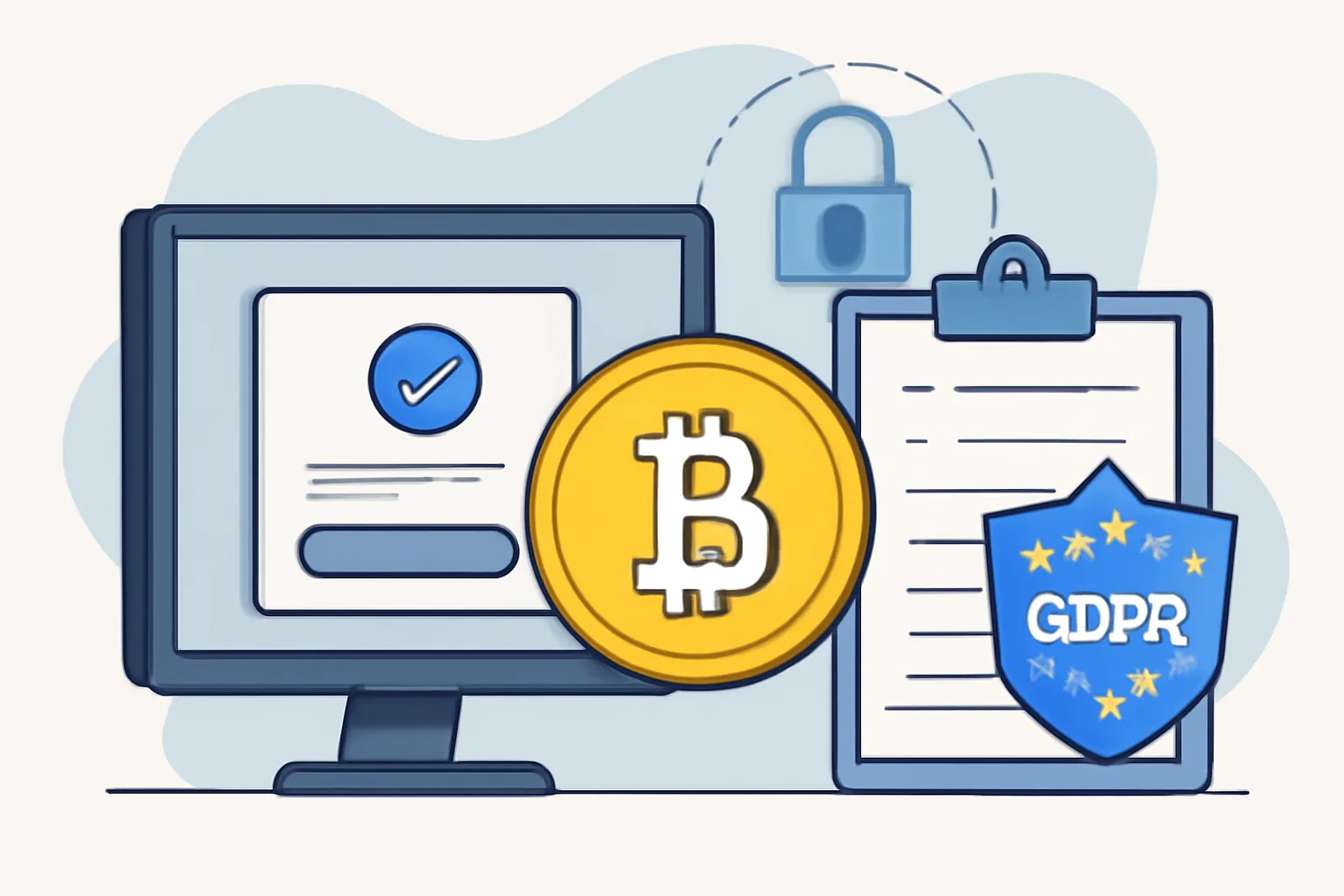
GDPR and crypto payments intersect because GDPR is the European Union’s data protection law, and it applies to many businesses that touch personal data from EU residents, even if the payment itself is made in Bitcoin, USDT, or another token. A merchant in London, a SaaS company in Lisbon, or a gateway processing invoices for customers in Germany can all end up in scope. The rule is simple: if you handle personal data, GDPR can follow you.
Crypto payment flows still involve names, emails, wallet addresses, device data, and support tickets. That is enough. A wallet may look like a string of random characters, but it can still be tied to a person through billing records, KYC files, or transaction patterns. One invoice can connect several data points at once.
Businesses often assume crypto means less privacy risk because no card number is stored. That assumption breaks fast. A payment request can carry an order ID, shipping address, refund note, and IP address, all in one workflow. The payment rail changes, but the compliance question stays.
For merchants, the issue is not theory. A simple checkout, a chargeback dispute, or a refund can create a paper trail that includes personal data and business decisions about why it was collected. If you also use a crypto payment gateway for ecommerce guide, the same privacy questions tend to appear at setup time, not after launch. That is the moment to ask who sees what.
How Personal Data Appears in Crypto Transactions
Personal data appears in crypto transactions in more places than many teams expect. Wallet addresses are the obvious one, but they are only the start. IP addresses, browser fingerprints, invoice numbers, delivery details, and customer service logs can all become part of a payment record. Even a timestamp can matter when combined with another identifier.
KYC checks are another common source. A provider may collect a passport scan, a selfie, proof of address, or a company registration document before allowing higher-value transactions. That material clearly falls under data protection rules. So do risk scores, blocked-user lists, and manual review notes written by a compliance team.
On-chain metadata also matters. A memo field, payment reference, or embedded order code can reveal more than intended. Some businesses add customer names or email fragments to transaction labels because it makes reconciliation easier. It also makes the record more personal. A public chain does not forget that detail.
There is a practical point here. If your checkout is built for speed, you may still need to ask which fields are optional and which are mandatory. One extra field can change the legal picture. The same is true for refunds, where a support agent might ask for a wallet address, transaction hash, and proof of purchase in the same ticket.
For teams that want a calmer first pass, how to test a crypto payment is worth reading before any production launch. Testing shows which data points are collected by default, which can be removed, and which are only there because nobody questioned them during implementation. That small exercise can save a later cleanup.
GDPR Roles in a Crypto Payment Setup
GDPR uses two main roles: controller and processor. The controller decides why and how personal data is processed. The processor handles data on the controller’s behalf. A merchant is often the controller for customer checkout data, but the answer is not always that neat.
A payment gateway may be a processor for payment instructions, yet become a controller for its own fraud prevention or fraud scoring. An exchange can be a controller for account onboarding and a processor for certain merchant-related services. A wallet provider may sit somewhere different again, depending on the service terms and the actual data flow. Contracts matter, but facts matter more.
Role mapping should be written down. Not in a slide deck, but in a real internal record. That record should say who handles invoice data, who receives IP logs, who stores KYC files, and who answers a user deletion request. If three vendors touch the same record, their roles should not be guessed.
This is one place where a merchant can get caught by a small detail. A crypto payment provider that only transmits payment confirmations may still use customer metadata for risk checks. If that happens, the provider may not be acting purely as a processor for every activity. A clean contract helps, but the data flow decides the outcome.
Lawful Bases for Processing Payment Data
Businesses need a lawful basis before processing personal data. In GDPR and crypto payments, three bases usually come up first: contract necessity, legal obligation, and legitimate interests. Contract necessity covers the data needed to complete the payment or provide the service. If a customer buys a digital product and pays in crypto, you may need the email address, wallet address, and order reference to finish the transaction.
Legal obligation applies when a law requires retention or reporting. Tax records, accounting logs, and anti-money-laundering checks can all fall into this category. The key point is narrowness. If a rule requires one record for seven years, that does not mean every log should be kept for seven years.
Legitimate interests often support fraud prevention, security monitoring, and abuse detection. That basis is not a free pass. A business still needs to weigh its interests against the rights of the individual. A short balancing test is better than a vague promise that “security needs it.”
Consent appears in some crypto workflows, but it should not be used as a shortcut for everything. If the service cannot function without certain data, contract necessity may be the better fit. If marketing wants to reuse payment data for email campaigns, that is a different discussion. One dataset, two purposes, two legal questions.
For merchants working with recurring billing, payora with WHMCS automated billing can be a useful operational example because recurring invoicing makes retention and purpose limits easier to overlook. Monthly charges create a steady stream of records, and steady streams are where sloppy logic starts to hide.
Key GDPR Risks in Crypto Payments
Excessive data collection is a common risk. A checkout form asks for name, email, phone number, company name, billing address, shipping address, and Telegram handle. For a digital service, that may be too much. Collecting more than needed increases the compliance burden and the damage if something goes wrong.
Retention is another weak spot. Teams sometimes keep payment logs “just in case” for years after the business need is gone. GDPR expects a real retention rule, not a shrug. If a refund window closes after 30 days, that may be a meaningful retention marker. If an invoice archive must stay for accounting reasons, say so and separate it from the rest.
Cross-border transfers deserve careful handling. A customer in France, a gateway server in Singapore, and a support desk in the United States can create a transfer chain that needs safeguards. Standard contractual clauses, transfer assessments, and vendor due diligence may all come into play. A map of where data goes is not optional.
The immutability of blockchain records creates a different problem. Once data is written on-chain, deleting it is often impossible in the ordinary sense. That is not a technical footnote. It is the central tension between privacy law and design. Businesses that put names or email addresses on-chain are taking a deliberate risk.
There is also the issue of overexposed metadata. A public transaction history can let third parties infer customer behavior, order size, and timing. A competitor does not need a full customer profile to learn a lot from repeated transfers. A chain with no names can still leak patterns.
One more risk is vendor drift. A provider may change its logging practice, add a new analytics tool, or expand fraud rules without telling every merchant on day one. That is why a privacy review should not be a one-time exercise. If you later need how to fix a failed crypto integration issue, the same vendor review should still be part of the incident response notes.
Compliance Measures for Merchants and Payment Providers
Start with data minimization. Collect only what is needed for the transaction, the refund, or the legal record. If a field is optional, mark it optional. If a wallet address is not needed until payment confirmation, do not request it at account signup. That sounds obvious, and yet it is missed every week.
Privacy notices should be specific. They should name the categories of data, the reasons for processing, the retention periods, the recipients, and the transfer countries. A generic “we respect your privacy” line is not enough. If customers can pay in crypto, the notice should say so plainly and explain which transaction data is stored.
Access controls matter because payment records often mix business and personal data. Only staff who need invoice data, support tickets, or KYC files should be able to open them. Use role-based access, separate admin accounts, and logs that show who accessed what and when. If one support agent can see everything, the system is too open.
Retention policies should be written in days or months, not vibes. One bucket for accounting records, one for fraud logs, one for support tickets. Then define deletion or anonymization steps for each bucket. If a legal hold applies, note the exception. If not, delete on schedule.
Vendor management should include contracts, security checks, and data flow reviews. Ask every provider where data is stored, which subprocessors are used, and how breach notices are delivered. Encryption should cover data in transit and at rest, and key management should not be treated as an afterthought. A copied key file in a shared folder is not a strategy.
Blockchain, On-Chain Transparency, and Right to Erasure
Blockchain makes privacy requests harder because the record may be permanent. GDPR gives people rights to access, rectification, and erasure in certain cases, but a public chain does not offer a delete button. That tension does not disappear because a business calls the payment “decentralized.”
What can be removed is usually off-chain data. A merchant can delete a customer profile, a support ticket, or an invoice record stored in its own database, subject to retention rules. A chain entry cannot always be erased, but a linked database record often can. That difference matters in practice.
Design choices help. Keep personal data off-chain where possible. Store only a tokenized reference or a transaction pointer on-chain, then keep the identifying details in a controlled database. If you must use a public ledger, avoid putting names, emails, or addresses in transaction notes. A reference code is safer than a human-readable label.
Some teams ask whether hashing solves the problem. Not by itself. A hash can still be personal data if it can be linked back to a person or if the original data is available elsewhere. Pseudonymization is useful, but it is not magic. The law looks at the chance of re-identification.
There is a practical compromise here. Use off-chain storage for customer identity and payment administration, and reserve the blockchain for settlement. That keeps the public record lean. It also makes it easier to honor a deletion request for the parts you control, which is usually where the operational work sits.
Practical Checklist for GDPR-Aware Crypto Payment Operations
Review the privacy policy first. Check whether it mentions crypto payment data, wallet addresses, fraud checks, KYC, international transfers, and retention periods. If those items are missing, the policy is incomplete. One page of careful language beats three pages of vague comfort.
Map every transaction field. Name the source, the purpose, the recipient, and the storage location for each field. Do this for checkout, refunds, support tickets, accounting exports, and risk scoring. If the same field appears in 4 systems, all 4 need review.
Confirm controller and processor roles in writing. Make sure the merchant agreement, gateway contract, and any subprocessor list match the actual flow of data. If a vendor changes its service, update the record. One outdated clause can mislead an audit.
Check international transfers and legal bases together. A payment flow can be lawful under contract necessity and still need a transfer mechanism for foreign hosting or support access. Those are separate questions. Treat them that way.
Train support and finance teams on incident handling. A leaked invoice, a mistaken refund to the wrong wallet, or an emailed screenshot can become a privacy event. Staff should know who to notify within the first hour, what evidence to preserve, and when to stop sending files by email. A clean escalation path matters on a Friday afternoon.
Set a review date. Privacy controls age quickly, especially when a gateway adds new logs, new fraud checks, or a new region for storage. Quarterly reviews work better than a yearly panic. The risk does not wait for the calendar.
And if your business is still choosing its setup, ask one final question before launch: can every payment step be explained in plain language to a customer, a lawyer, and an auditor without changing the story? If the answer is no, the crypto payment flow is not ready yet.



Comments