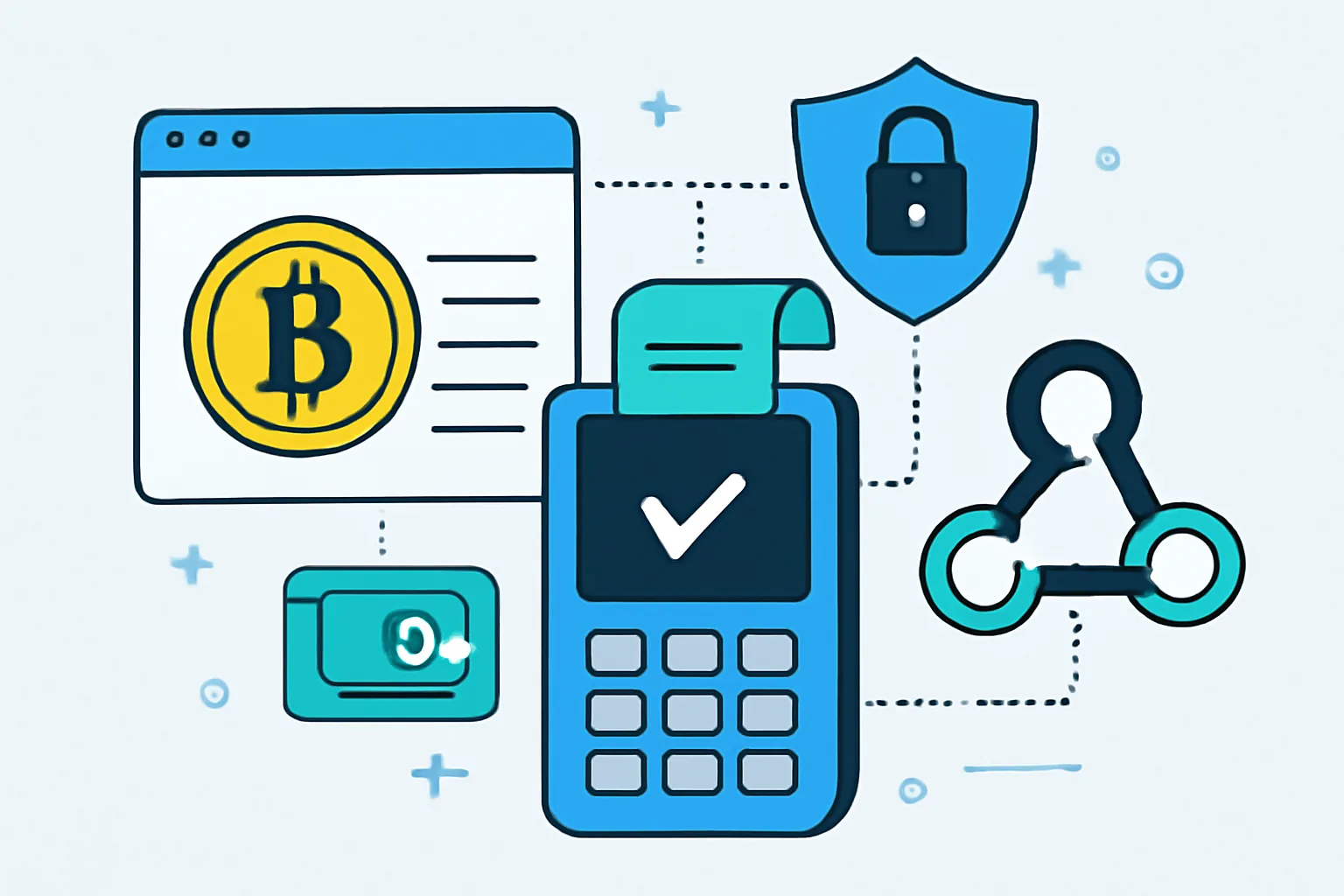
What a Crypto Payment Gateway Webhook Is
A crypto payment gateway webhook is a server-to-server message. It tells your site that something changed: a payment was sent, a transaction confirmed, an invoice expired, or a refund was created. The webhook usually arrives as an HTTP request with a JSON payload, and your server reads that payload before changing the order status in your database.
That sounds simple, and in one sense it is. A merchant creates an order for 120 USDT, the customer pays, and the crypto payment gateway sends a webhook that says “paid” once the transaction reaches the required confirmations. Your checkout page does not need to keep refreshing. Your staff does not need to guess. The webhook does the reporting.
There are often several event types. One webhook may announce that a payment is pending, another that it is confirmed, and another that it failed or timed out. Some systems also send invoice creation, partial payment, or overpayment notices. If you have read a Crypto Payment Gateway for Ecommerce Guide — Payora, you have already seen why these events matter for order handling. A webhook is the part that keeps the cart, the invoice, and the accounting record aligned.
One short rule helps here: do not treat the webhook as decoration. It is the source of truth for order updates. If the gateway confirms a payment and your server never records it, the customer support inbox gets the blame. If the webhook is faked, the store loses money. Both outcomes are ordinary, and both are avoidable.
Why Webhook Security Matters
Webhook security matters because the webhook can change money states. A forged event can mark an unpaid order as paid. A replay attack can submit the same “confirmed” webhook twice. Tampering can alter amounts, transaction hashes, or destination addresses. Unauthorized order status changes can move a ticket from “awaiting payment” to “fulfilled” with a single bad request.
The business impact is not theoretical. A merchant may ship goods, unlock a license, or provision hosting based on one webhook. If the webhook handling is weak, a stranger can trigger delivery without a valid payment. That creates charge disputes, refunds, manual reversals, and a support queue full of screenshots. A small mistake becomes a real loss.
Here is the awkward part: many teams secure the checkout page and ignore the callback endpoint. The client sees a lock icon. The webhook endpoint is left open. That gap is enough for an attacker to target the crypto payment gateway webhook security layer instead of the payment page, which is usually easier and less watched.
One bad event can do more damage than ten failed logins. The reason is simple. Webhooks act on business logic.
Core Security Practices for Webhook Endpoints
Start with HTTPS. Every webhook endpoint should require TLS, because plain HTTP hands event data to anyone watching the network. The endpoint URL itself should be hard to guess, but secrecy alone is not security. A random-looking path is not a shield.
Next, webhook signature verification with a shared secret or public-key method provided by the crypto payment gateway. The webhook payload should be rejected unless the signature matches exactly. If the provider signs the body and timestamp together, your code must verify both. Do not parse first and check later. That order invites trouble.
Some teams also use IP allowlisting where appropriate. That can help, but it should never replace signature verification. Gateway IP ranges can change. Proxies can hide the original source. A list of permitted addresses may reduce noise, yet it is still only one control among several.
Validate the payload before using any field. Check the transaction ID, the amount, the currency, the merchant reference, and the expected status. Reject requests that contain extra fields you do not recognize, or values that do not match the order. A webhook that claims a payment of 1,000 USDT for an order created for 100 USDT is not a success story.
Keep the endpoint locked down. Allow only the route that receives webhooks. Remove debug handlers from production. Limit who can view logs. One open admin panel is enough to expose secrets, payloads, and error traces. That is why endpoint access controls belong in the first build, not as a cleanup task later.
How to Verify Webhook Authenticity
Verification usually starts with the signature. The provider sends a signature header, your server computes its own signature from the raw request body, and both values must match. If the body changes even slightly during parsing, the comparison fails. That is why raw-body access matters. One newline can break the check.
Timestamp checks come next. A valid webhook should arrive within a short window, not hours later. If the gateway includes a timestamp, reject anything outside the allowed range. This helps with preventing webhook replay attacks, where an attacker copies a real webhook and sends it again after the payment has already been processed.
Nonce or event ID checks make replay protection stronger. Store the event ID once, then refuse the same ID again. Many merchants keep this in a table with the order reference and the final status. The important part is simple: every processed webhook needs a memory. Without that memory, the same confirmation can be accepted twice.
Compare event data against your own records. If the webhook says order #4482 is paid for 250 USDT, your database should already know that order #4482 expects 250 USDT. If the amounts differ, stop the workflow and alert a human. This step catches tampering, stale events, and mismatched references in one check.
That comparison should be exact. The payment hash, invoice number, currency, and merchant account should all match. A merchant who accepts multiple coins needs this especially badly, because a BTC payment and a USDT payment can be confused in a rushed implementation. The gateway is not the place to guess.
Common Vulnerabilities and How to Avoid Them
One of the oldest mistakes is trusting client-side callbacks. A browser redirect is not proof of payment. A customer can close a tab, alter a URL, or send a fake success message from the browser console. The webhook, not the browser, should update the order.
Debug logs cause trouble too. Logs often contain full payloads, secret headers, and stack traces. That is helpful during development and dangerous in production. If logs are copied into a support channel or stored in a shared bucket, the webhook secrets may be exposed. Keep logs narrow. Redact what you do not need.
Weak secrets are another problem. A short token or reused API key gives attackers a better chance of guessing the verification material. Rotate the secret if there is any sign of exposure. Use a long value. Store it outside the codebase. Secrets should not sit in a repository next to the webhook handler.
Missing idempotency creates duplicate processing. A payment gateway may retry delivery if your server times out. That is normal. Your code must treat the second delivery as the same event, not a fresh payment. Without idempotency, one confirmed payment can trigger two shipments or two license activations.
Do not ignore duplicate delivery. The gateway may resend the same webhook after a network failure, and your endpoint should return success once the event is safely recorded. That means the handler must check whether the event ID is already processed before any side effect runs. One database flag can save a shipment.
There is also the problem of partial trust in middleware. A proxy, a cache layer, or a framework plugin may rewrite headers and break signature checks. Test the entire path, not just the handler in isolation. The secure path has to stay secure after deployment.
Secure Webhook Implementation Checklist
Use this checklist during development and before launch. A disciplined implementation catches more than code review alone.
- Require HTTPS for every webhook request.
- Verify the signature against the raw request body.
- Check the timestamp and reject stale requests.
- Store processed event IDs to prevent replay.
- Match amount, currency, and order reference against your database.
- Return the correct HTTP status code for success and failure.
- Keep secrets in environment variables or a secret manager.
- Restrict access to the webhook route and related logs.
- Use least-privilege logging so only necessary fields are recorded.
- Set safe retry behavior so duplicate deliveries do not double-process.
Each item has a practical consequence. A missing timestamp check makes replay easier. Weak logging can expose payment details. Poor retry logic can create duplicate orders. The list is short because the work is repetitive, not because it is easy.
Some merchants pair this checklist with payment testing. If you are still setting up a store, an how to test a crypto payment guide can help you stage transactions before customers see the checkout. That is useful, because a webhook that fails in test is a warning; a webhook that fails in production is a ticket.
Use a plain rule for access: only the application server should talk to the webhook endpoint. Humans should not call it manually except during controlled testing. If your team needs to simulate events, use a test environment and a documented tool. A live webhook route is not a playground.
Testing and Monitoring Webhook Security
Testing should include valid webhooks, invalid signatures, expired timestamps, duplicate event IDs, and altered payloads. Send a request with one changed character and confirm that the handler rejects it. Send the same event twice and confirm that the second one is ignored. These tests show whether crypto payment gateway webhook security is real or just written in a README.
Simulate malicious requests, not just happy-path events. Try a webhook with the correct structure and a bad signature. Try a payload with the right signature but the wrong amount. Try a delivery with an old timestamp. One good test suite can expose several mistakes before a customer does.
Monitoring should track failed signature checks, sudden spikes in retries, and unusual event patterns. If the gateway sends ten failed verifications in a minute, that is worth an alert. If event IDs repeat outside normal retry behavior, inspect the source. Strange patterns are often the first clue.
Keep an audit trail for incidents. The trail should show the request time, the event ID, the validation result, and the action taken by the system. Avoid storing full secrets in the audit record. A useful audit trail proves what happened without giving away more than it should.
One practical tip: keep a separate dashboard for webhook errors. Payment failures and webhook failures are not the same. A user may pay correctly while your endpoint still rejects the callback. That difference matters, because the remedy is different.
Best Practices for Ongoing Maintenance
Key rotation should happen on a schedule, not only after a scare. If a gateway supports multiple active secrets, rotate one while the other keeps the webhook alive. Then retire the old key after verification. A clean rotation plan prevents downtime and limits exposure.
Dependency updates matter because webhook handlers often sit inside frameworks, HTTP clients, and JSON parsers. A bug in any of those layers can weaken verification or logging. Review dependencies on a fixed cycle. If a package affects request parsing, test it twice before deployment.
Run periodic security reviews with one question in mind: can a forged webhook still change an order? That question is better than a long checklist when time is short. Review the endpoint, the signature code, the retry policy, and the error paths. One overlooked branch can undo the rest.
Prepare incident response before you need it. Decide who can disable the webhook, who checks logs, and who informs operations if duplicate confirmations appear. A documented response saves time during a real event. The first hour matters.
Keep webhook documentation aligned with provider changes. Gateway event names, headers, or signing rules can change after an API update. If the docs shift and your handler does not, the next webhook may fail without warning. Update the code and the notes together.
If you also accept recurring or subscription-style payments, webhook changes can affect billing flow as well. Merchants who handle hosting or VPS orders often pair this work with a how to accept crypto payments setup, where webhook handling decides whether a service stays active or gets suspended. That is a direct consequence, not a theoretical one.
One final habit helps: review the webhook endpoint after every provider notice, deployment, or payment method change. A 20-minute review can catch a broken signature rule before a weekend of false declines. Small checks, repeated on schedule, keep the webhook honest.



Comments