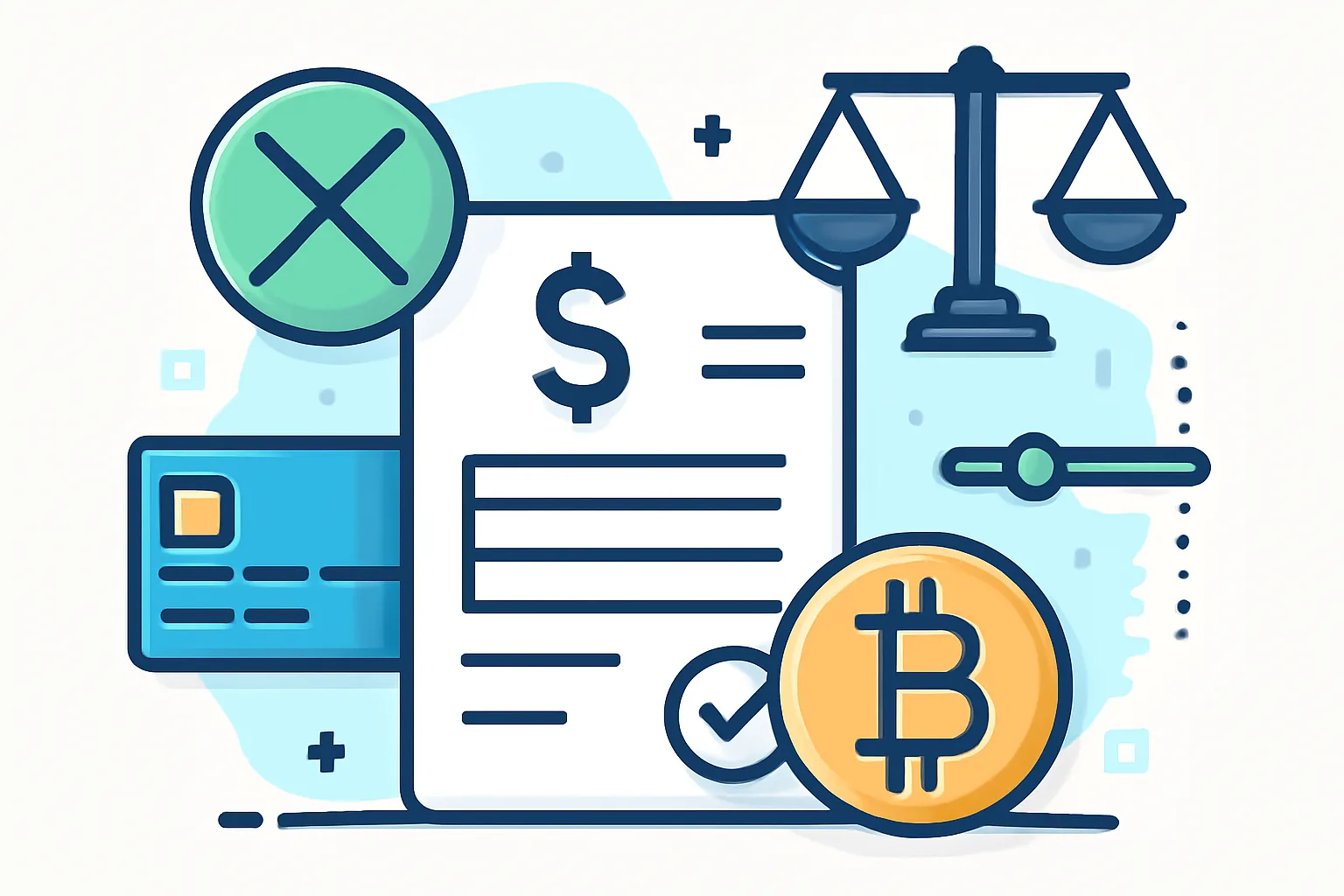
What “crypto payment invoice limits” means
Crypto payment invoice limits are the rules that cap how much value can sit on one invoice, or how much value can be accepted through one invoice request. The number can be a fixed ceiling, a floor, or both. A merchant might set a 50 USDT minimum for one order and a 5,000 USDT maximum for another.
That sounds close to payment limits, but it is not the same thing. A payment limit controls the transfer itself; an invoice limit controls the bill you present to the customer. One invoice can ask for 2,000 USDC, while the payment limit on the processor side may still allow a larger settlement flow across several invoices or several days.
Common use cases are easy to spot. A freelancer may cap one invoice at 1,000 USDT. A wholesale seller may split a 25,000 USDT order into three invoices. A subscription business may set a minimum invoice amount so tiny refunds do not clog accounting. These choices are practical, not decorative.
If your business is moving from card payments or bank transfer workflows, the invoice logic will feel familiar. The difference is speed. Crypto moves fast, and the invoice has to keep up. For a broader setup view, the crypto payment gateway for ecommerce guide is useful, especially if your checkout has more than one payment method.
Why crypto invoice limits exist
Limits exist because money flow needs guardrails. Compliance teams want to know where large payments come from. Risk teams want to stop obvious abuse. Finance teams want invoices that are easy to reconcile. None of that is glamorous, but every one of those reasons can save hours later.
Network fees are another reason. On some chains, a small invoice can be eaten by transaction costs or become awkward to settle. A 7-dollar invoice on a congested network may be a nuisance for everyone involved, especially if the sender underpays by a few cents and the payment then sits in limbo.
Volatility also matters. A quote that looks fine at 09:00 may be wrong by 09:15. That is one reason businesses set expiry windows and size limits together. A merchant that sells tickets, digital goods, or services with thin margins usually feels this first.
Operational controls matter too. If every invoice can be any size, refund handling gets messy, approvals take longer, and support tickets multiply. Some processors also impose how to test a crypto payment before going live, because invoice limits are easier to spot in test flows than after a customer has already paid.
Common types of invoice limits
Fixed invoice caps are the simplest type. You decide that no invoice can exceed a set amount, such as 10,000 USDC, and the system rejects anything above it. This is common for online services, where a single invoice should never represent a massive exposure.
Per-transaction limits work differently. One invoice can accept only one payment up to a stated amount. If the customer tries to overpay, the invoice may be marked as invalid or require a new request. This is useful when the payment flow is tied to one order number and one settlement event.
Daily and monthly limits are used when the business wants volume control rather than order control. A merchant may allow many invoices, but only up to 100,000 USDT per day. That helps treasury teams sleep better, which is not a technical feature, but it does count.
Minimum invoice amounts are common too. A business may reject invoices below 25 USDC because the support cost is higher than the revenue. Currency-specific restrictions also appear often. One processor may allow BTC invoices up to one threshold, while ETH or stablecoin invoices have different levels because fees, confirmation times, and settlement handling are not identical.
| Type | What it controls | Typical reason |
|---|---|---|
| Fixed cap | Maximum invoice amount | Risk control |
| Per-transaction limit | One payment against one invoice | Order accuracy |
| Daily/monthly limit | Total invoiced volume | Treasury control |
| Minimum amount | Lowest invoice value | Fee efficiency |
| Currency-specific limit | Amount by coin or token | Network and settlement differences |
Factors that affect invoice limits
Processor policy comes first. One provider may accept large invoices for verified merchants and smaller invoices for new accounts. Another may keep strict defaults until a merchant provides documents, reserves, or trade history. Those choices are often not visible to customers, but they shape the entire invoice flow.
Blockchain choice matters just as much. BTC, ETH, and stablecoins behave differently under load, and fee patterns are not the same. A business that accepts one asset on-chain may need a lower invoice ceiling than a business that settles mostly in stablecoins. The chain itself can change the practical limit.
Wallet type can matter. A hosted wallet, a non-custodial wallet, and a business treasury wallet do not carry the same control profile. Jurisdiction matters too. A merchant serving the EU, the UK, and Latin America may face different KYC/AML expectations, and those expectations can shape invoice limits.
Settlement method also plays a part. If invoices settle instantly to fiat, the merchant may tolerate larger invoices than if settlement is delayed or routed through a manual review queue. Businesses that need closer compliance controls often compare their setup with is non-custodial crypto payment processing legal before they decide how much flexibility to allow.
How invoice limits affect merchants and customers
For merchants, the first effect is checkout behavior. If the invoice limit is too low, a customer with a 12,000 USDT order may be forced to split the order into two or three payments. That is workable, but it creates more room for error and more support messages.
Customers feel it as friction. A buyer who expected one payment may now need to confirm several invoices, copy several addresses, or watch several countdown timers. The process is manageable, yet it becomes annoying fast if the steps are not explained in plain language.
Refunds can also become tricky. If a customer underpays by 3.50 USDC, the merchant has to decide whether to request the missing amount, issue a partial refund, or cancel the invoice. Overpayments create a different problem. A business may need to keep the extra amount on account, refund it, or open a manual ticket, and each option has accounting consequences.
Large B2B transactions feel the effects most sharply. A supplier invoicing 80,000 USDT may need staged billing, approval checks, and a payment window that does not expire too quickly. A few businesses also tie invoice limits to their own internal approval ladder, because no one wants a junior staff member sending a 6-figure payment without review. That one detail prevents ugly surprises.
How to set appropriate invoice limits
Start with fraud prevention, then work backward. Ask what the largest normal order looks like over 30 days, what the average refund size is, and how much exposure your team can tolerate if one invoice goes wrong. A limit should fit real sales, not wishful thinking.
Cash flow comes next. If the invoice limit is too low, your team may spend time stitching together multiple payments for one sale. If the limit is too high, you may sit with a large invoice that is hard to reconcile or reverse. A business that sells services may choose a higher minimum and a modest maximum, while a marketplace may do the opposite.
User experience matters, but not in a vague way. A checkout page with four warnings and two manual steps will lose buyers. A checkout page with one clear ceiling, one clear timer, and one clear address is better. That is why many teams review the payment flow together with invoice policy, especially if they also sell in fiat and crypto.
Accounting needs should shape the final number. If your finance team closes books weekly, a 90-day invoice window may be a bad fit. If you track revenue by project code, invoice limits should align with that code structure. One rule that helps: set the limit where support, finance, and risk can all explain it in one sentence.
For freelancers and small agencies, a lighter approach often works best. The crypto payment gateway for freelancers article shows how invoicing can stay simple without giving up control, which matters when one late payment can disrupt the next project.
Best practices for managing crypto invoices
Give clear payment instructions on every invoice. Name the coin, the amount, the wallet, the network, and the expiration time. If the invoice is for 1,250 USDC on Polygon, say that plainly. Customers should not have to guess which chain you meant. Ambiguity causes the wrong kind of support ticket.
Use exchange-rate expiry windows. A 10-minute window may be fine for a small retail sale, while a larger B2B invoice may need a longer one. The point is to stop stale quotes from drifting away from the actual market price. If the timer expires, issue a new invoice instead of forcing staff to patch old numbers by hand.
Monitor pending payments actively. An invoice that is half-paid at 14:20 may be fully paid by 14:25, or it may never complete. Your team should know when to wait, when to warn, and when to cancel. That is also where how to track crypto payment conversion becomes useful, because coin-by-coin tracking helps you see which invoice limits are doing their job and which ones are causing drop-off.
Handle underpayments and overpayments with written rules. If a customer sends 98 USDT against a 100 USDT invoice, decide in advance whether you accept the shortfall, ask for the difference, or void the invoice. If someone sends 102 USDT, decide whether the extra 2 USDT is refunded or credited. These tiny cases add up.
Keep records of the exact limits that apply to each merchant account. A support agent should be able to answer a customer in under 2 minutes, not after three internal messages and a hallway conversation. That speed matters more than perfect wording.
When to review or change your limits
Review invoice limits when your business grows by a noticeable step, not only at year-end. A shop that handled 200 invoices per month may need new limits after it reaches 2,000. The old ceiling may now block legitimate orders, and that is a self-inflicted problem.
New markets are another trigger. If you begin selling into a new jurisdiction, your KYC/AML obligations may change, and your invoice limits may need to change with them. New processor terms can do the same thing. One provider may tighten its rules after a risk review, while another may expand limits after successful transaction history.
Shifting payment volumes matter as well. A sudden jump in high-value orders can expose weak invoice settings within days. A fall in volume can also be a reason to simplify limits, especially if support tickets show that customers keep missing the threshold by small amounts. That pattern is easier to fix than a full policy rewrite.
Processor changes deserve a fresh look every time. If you switch settlement methods, wallet architecture, or compliance tools, the old invoice limits may no longer fit. Teams that handle crypto billing well usually document the limit, the reason for it, and the review date in one place, then revisit it after major operational changes or compliance updates.



Comments