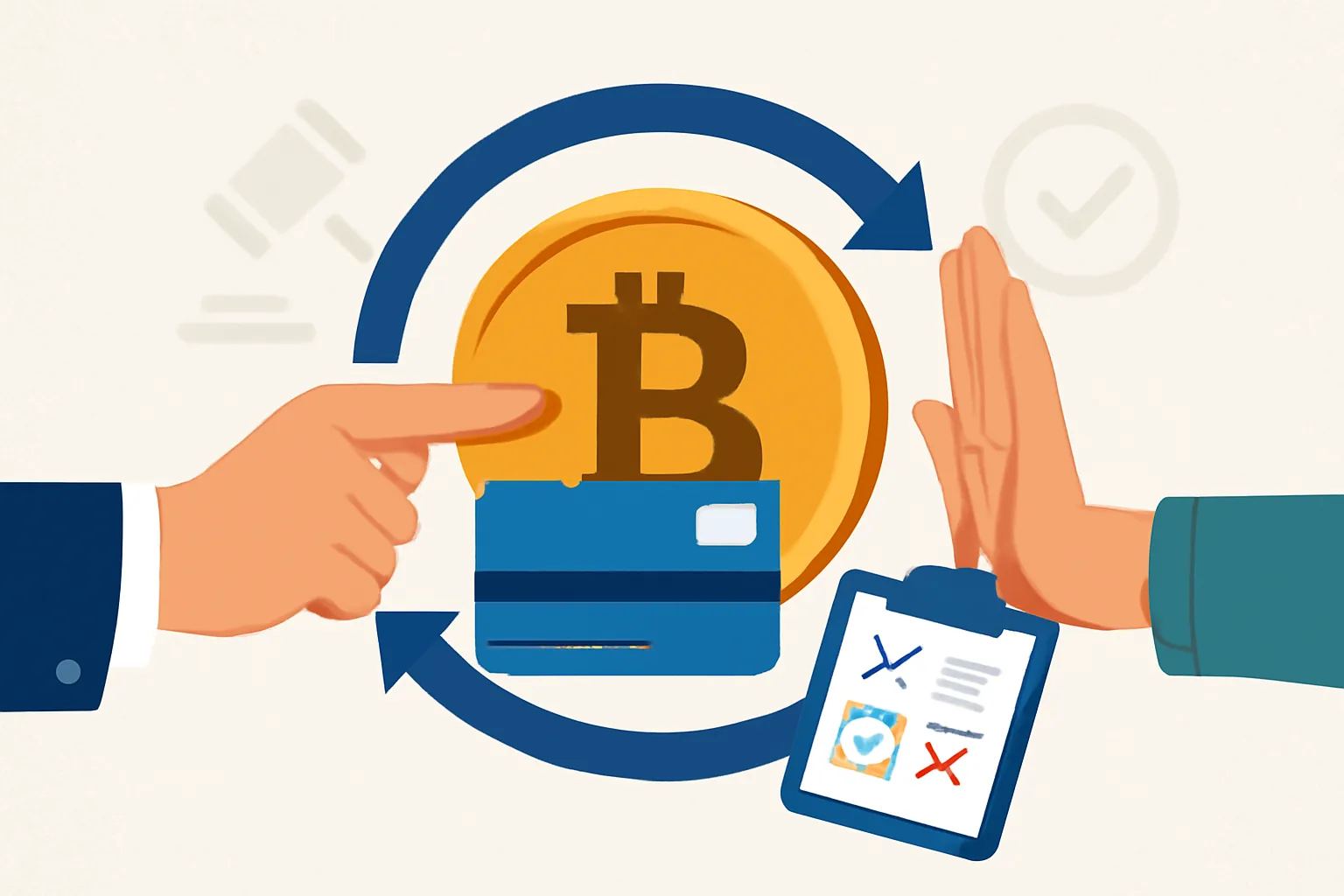
1. Understand what a crypto chargeback dispute is
A crypto chargeback dispute is not the same thing as a card chargeback. On a card, a bank can pull funds back after the fact. With crypto, the transfer usually settles on-chain and stays there. That difference matters on day one.
In plain terms, Bitcoin, stablecoins, and most other coins do not work like cards with a built-in reversal button. If a payment went directly from one wallet to another, the chain itself will not reverse it for you. A third-party payment processor can change that picture, because some processors hold funds, mediate disputes, or delay settlement long enough to review a claim. That is why the phrase how to handle crypto chargeback disputes starts with one blunt point: first identify whether there is any middle layer at all.
Direct wallet-to-wallet transfers are usually final. Final means final. If you sent funds to the wrong address or the buyer says they never approved the payment, the chain will not care unless another service sits between the two sides. Traditional chargebacks, by contrast, are governed by card networks and bank rules, so there is a formal reversal path and a separate dispute process.
2. Identify the type of transaction and platform involved
Start with the payment type. Was it Bitcoin, USDT, USDC, another stablecoin, or a different coin? Was it sent from a self-custody wallet, an exchange account, or a custodial processor? The answer decides your options. A customer who paid through an exchange and then used an internal transfer feature may have different support routes than a customer who sent funds from MetaMask to a merchant wallet.
Platform names matter too. An exchange, a payment gateway, a marketplace, and a custodial processor each set their own rules. Some services can pause a transaction if it is still pending. Some can only review a complaint after settlement. Others will ask for a ticket number and then point you back to the merchant’s refund policy. That is not a polite shrug; it is the process.
Write down the exact route the payment took in one sentence. Example: “The buyer paid 250 USDT from an exchange account through a payment gateway into our merchant wallet.” That one line saves time later, because support teams hate guesswork and you do too. If you are building a payment stack for a store, the crypto payment gateway for ecommerce guide can help you map which role each platform plays before any dispute happens.
3. Gather all transaction evidence
Every crypto chargeback dispute needs a paper trail, even if the “paper” is mostly screenshots and hashes. Collect the wallet addresses for both sides, the TXID or transaction hash, the invoice, the order confirmation, delivery proof, refund policy, and every relevant customer message. If you have five receipts, keep five receipts. Simple rule.
Good evidence is specific. A wallet address proves where funds moved. A TXID proves the transfer happened. An invoice shows what the buyer agreed to buy, on what date, and for what amount. Delivery proof might be a tracking number, a signed handoff, a login record, or a service completion note. For digital goods, a server log or access timestamp can matter more than a courier label.
Chat logs often decide the tone of the case. Save the entire thread, not just the angry paragraph. The one message where a customer approved a replacement or asked for a delay may matter more than the refund demand sent three days later. Keep screenshots with timestamps visible. Keep email headers if you can. Keep the exact amount in the original currency and the crypto equivalent, because disputes sometimes get messy when exchange rates move fast.
If your merchant team accepts crypto through invoicing, a dedicated workflow helps. The crypto payment gateway for freelancers article is useful here, especially if your invoices and payment confirmations need to line up before support will listen.
4. Review the relevant terms, policies, and settlement rules
Before you answer the buyer, read the merchant refund policy. Read it line by line. Then read the processor terms, the exchange rules, and any marketplace policy that applies to the transaction. A lot of disputes turn on one sentence buried in a policy: no refunds after delivery, refunds within 7 days, partial refunds for damaged goods, or arbitration through the platform’s support desk.
Consumer protection and arbitration rules can matter too, but they vary by country and platform. If the buyer paid through a service that offers formal escalation, the support team will usually ask whether the merchant policy was shown before checkout. If you hide the refund terms, your position gets weaker. If you show them clearly and keep a copy of the exact version the buyer saw, your position gets stronger.
One practical detail: match the policy to the exact payment path. A platform may have one rule for custodial balances and another for direct transfers. A customer dispute on a marketplace can also be governed by the marketplace’s own settlement rules, which may override your default refund wording. That is annoying. It is also where many merchant mistakes start.
If you are unsure how your setup handles payment flows and dispute exposure, the how to test a crypto payment guide is a useful check before you accept the next order.
5. Contact the other party and try to resolve it
Open the conversation calmly and in writing. State the disputed amount, the transaction date, the TXID, and the order number. Do not argue about motive in the first message. Ask for one clear thing: a refund, a partial refund, or confirmation of receipt. Short messages work better than a dramatic wall of text.
A solid first reply might say: “We see your payment of 180 USDT on 14 May. We delivered the file on the same day. If there is a problem with the order, please tell us which item is missing and we will review a refund or replacement.” That sentence gives names, dates, and a path forward. It also avoids the classic mistake of denying everything before you know what the complaint is.
Sometimes a partial refund makes more sense than a full one. If the buyer received part of the service, offer a percentage tied to the missing work. If the product can be replaced, say so. If the issue is a duplicate payment, confirm which transfer will be returned and when. Keep every promise in writing. A phone call can help, but it should always be followed by an email or ticket note.
One small aside: calm is not the same as weak. A documented negotiation looks professional, and it helps later if support staff need to see who tried to fix the problem first. No drama. Just facts.
6. Escalate through the correct support channel
If direct contact fails, go to the right support team, not the nearest one. For an exchange payment, contact the exchange. For a payment gateway, contact the gateway’s support desk. For a marketplace sale, open the marketplace dispute channel. For a custodial wallet service, ask the wallet provider whether they can review the case or freeze related balances. Wrong inbox, wrong result.
Send a dispute packet that can be read in under 5 minutes. Include the TXID, wallet addresses, invoice, order confirmation, customer messages, refund policy, delivery proof, and your requested outcome. Put the disputed amount at the top. Put the dates in order. If the platform accepts attachments, label them clearly: 01-invoice, 02-TXID, 03-delivery-proof, 04-chat-log. Support teams love numbered files more than mystery PDFs.
Be specific about what you want the platform to do. Ask for mediation, review, settlement hold, account notes, or arbitration if those options exist. If the processor can only pass the complaint to the merchant, say so in your own notes and move back to direct negotiation. If the platform has a published complaint path, follow it exactly, because a missing field or an unclear subject line can slow the case by days.
For merchants managing repeat payments, billing systems, and support tickets together, payora with WHMCS automated billing can help you keep order records and support notes aligned before a dispute grows legs.
7. Protect yourself for future crypto payments
Future disputes get easier when the payment setup is clear before the first coin moves. Use escrow or a reputable processor if the order size justifies it. Verify the address twice. Then verify it again. One wrong character in a wallet address can turn a normal sale into a permanent loss, and the chain will not fix that for you.
Write refund and dispute terms before you accept crypto, not after. Put the terms near checkout, on the invoice, and in the order confirmation. State the refund window in days. State whether partial refunds are allowed. State whether a customer can cancel before delivery. If you serve EU customers, privacy and record handling may also need GDPR and crypto payments review, because the payment trail can become a data trail very quickly.
Keep records for every order, even the tiny ones. Save the invoice, the payment confirmation, the customer name if you have it, and the delivery note. A $50 order can become a $500 headache if nobody can find the original terms. That is not theory; it happens because staff rotate, inboxes fill, and memory is terrible after two weeks.
Escrow helps when trust is low. So does a processor that explains settlement timing in plain language. If your team handles recurring billing or subscriptions, define what counts as a successful payment, what happens on a failed transfer, and who owns the dispute record. One clear policy beats ten apologetic messages later.
| What to check | Why it matters | One concrete result |
|---|---|---|
| TXID and wallet addresses | Proves the transfer path | Support can match the payment |
| Invoice and order confirmation | Shows what was sold | Support can compare the claim |
| Refund policy and processor terms | Sets the dispute rules | You know which channel to use |
| Delivery proof and chat logs | Shows what happened after payment | You can answer a “not received” claim |
If you sell through a marketplace or run a recurring billing stack, the best defense is boring documentation. Keep each order tied to one folder, one timestamp, and one policy version. Boring wins. Every time.



Comments